
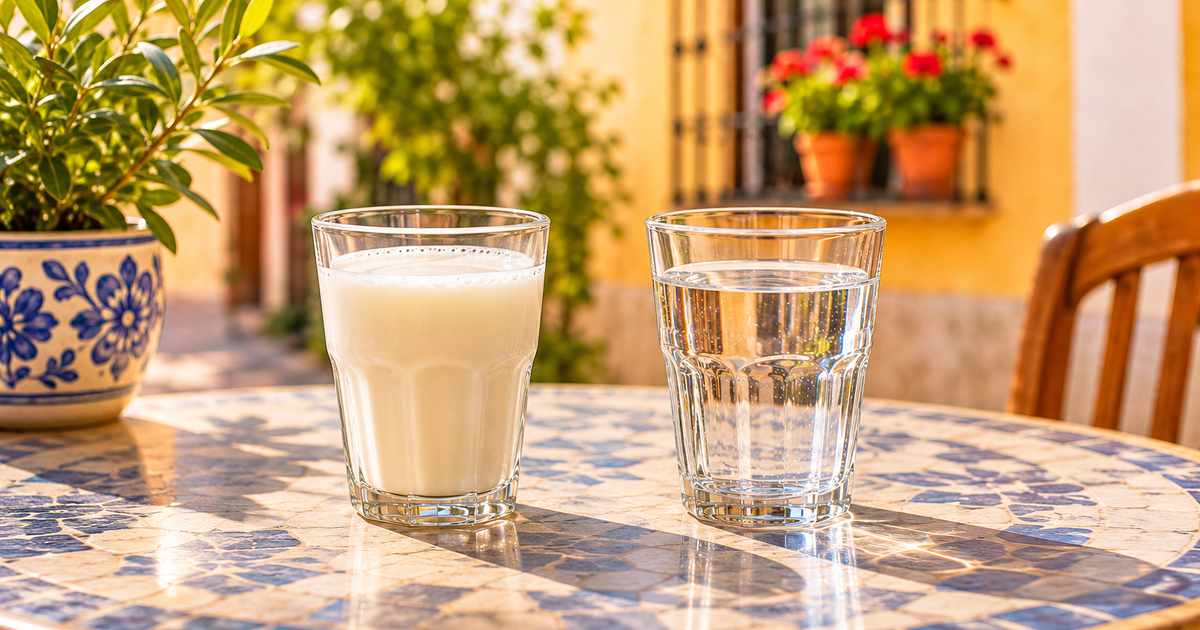
 AI-generated image
La leche y el agua
El or la? Learning Spanish gender as a Finn

Nov 6, 2026 · 10 min read
In Finnish, I have never once had to decide whether a table is male or female. Then I started learning Spanish, and suddenly every noun came with a question attached: el or la?
Spanish learners everywhere struggle with gender. For me it's not only a matter of remembering which word is which. My native language never gave me a place to keep that information.
The one that still fries my brain is turista. The word never changes, so there's no ending to help me. A mixed group is los turistas, a woman from that group is la turista, and a man is el turista. In Finnish, a turisti is just a turisti.
Finnish doesn't do gender. At all.
Most English speakers know that languages like Spanish, French and German sort their nouns into genders. Fewer know that some languages don't do it in any form. Finnish is one of them.
- No grammatical gender. A Finnish noun is just a noun. Pöytä (table), kirja (book) and kuu (moon) don't belong to any class.
- No articles. There is no word for "the" or "a". Kirja on pöydällä can mean "the book is on the table" or "a book is on the table", and context (and word order) decides.
- One pronoun for "he" and "she". Finnish uses hän for both. Finns often slip on "he" and "she" in English, even when their English is otherwise fluent. The distinction just isn't automatic for me.
I wasn't starting from zero, though. At school I learned Swedish, which sorts nouns into en and ett words. German gave me der, die and das, and French gave me le and la. So by the time I reached Spanish, I already knew that nouns can have genders and that the assignment is often arbitrary. What I had never done was pick one. Finnish never asked me to, and English only gave me "the" and "a", with no gender attached.
What Finnish does instead
Finnish has no articles, but word order, case and context do some of the same work. Whether something is already known or new often shows in the word order, and the case can say whether you mean all of something or only part of it:
- Pöydällä on kirja. — There's a book on the table. (New information tends to come last.)
- Kirja on pöydällä. — The book is on the table. (Known information tends to come first.)
- Söin kakun. — I ate the cake. (All of it.)
- Söin kakkua. — I ate some cake. (The partitive marks a part.)
And here's a detail native speakers rarely notice: spoken Finnish quietly uses se ("it, that") and yksi ("one") a lot like articles. Se mies tuli — "the man came". Siellä oli yksi tyyppi — "there was a guy". So Finnish speakers already have something like "the" and "a" in the spoken language. What we don't have is anything like el and la.
Why Spanish gender is more than one word
Your first assumption might be that gender is a vocabulary problem: memorise el or la and move on. It isn't. Gender doesn't stay on the article. It spreads to every word that agrees with the noun, and French and German do the same.
Finnish has agreement too, just not for gender. The adjective changes with the noun's number and case:
- valkoinen talo — a white house
- valkoiset talot — white houses
- valkoisessa talossa — in a white house
Spanish adds gender on top of that:
- La casa blanca es bonita. — The white house is pretty.
- El coche blanco es bonito. — The white car is pretty.
- Las casas blancas son bonitas. — The white houses are pretty.
The article, the adjective and the adjective after es all have to agree. Get the gender wrong at the start and all three go wrong with it. One small decision, three mistakes.
The distance is what really gets me. When the adjective sits right next to its noun, I'm fine. Push them apart and I lose track:
- El problema de las casas nuevas es complicado. — The problem with the new houses is complicated.
My brain wants to say complicadas, because casas is the closest noun. But the problem is the subject, so it has to be complicado.
It gets worse across sentences, where the noun has gone and only a pronoun is left:
- Perdí la llave del coche. La busqué por todas partes, pero no la encontré. — I lost the car key. I looked everywhere for it, but I couldn't find it.
By the second sentence, llave is gone from my head, and lo tries to slip in because coche was the last noun I said. English and Finnish never trained me for this. It and se don't care what the thing is.
The patterns that actually help
The good news is that Spanish gender is not random. It's mostly predictable, and the exceptions come in groups.
Endings that usually tell you
- Nouns ending in -o are almost always masculine: el libro, el vaso, el perro.
- Nouns ending in -a are usually feminine: la mesa, la casa, la ventana.
- -ción, -sión, -dad, -tad, -tud and -umbre are feminine: la canción, la ciudad, la libertad, la actitud, la costumbre.
- -aje and most nouns ending in -or are masculine: el viaje, el garaje, el color, el amor.
The exceptions that come in groups
- Greek words ending in -ma are masculine: el problema, el tema, el sistema, el idioma, el programa, el clima. (Not every -ma word, though: la cama and la forma are feminine.)
- Shortened words keep the gender of the long form: la foto (la fotografía), la moto (la motocicleta).
- A few true oddballs just need to be memorised: el día, el mapa, la mano.
Words ending in -e: no pattern at all
This is where I've stopped looking for logic. La noche, la leche, la gente, la llave. But el coche, el puente, el nombre, el hombre. There's no rule here. You learn the article together with the word or you guess.
Two traps I didn't see coming
El agua is feminine
El agua looks masculine. It isn't. Feminine nouns that start with a stressed a- sound take el in the singular, because la agua would run the two a's together. Everything else stays feminine:
- El agua está fría. — The water is cold. (Not frío.)
- Las aguas del río. — The waters of the river. (Back to las in the plural.)
The same happens with el águila (eagle), el hacha (axe) and el aula (classroom). Only the article changes. Everything else still agrees as feminine, even when it comes before the noun: la misma agua (not el mismo agua), esta agua. For a Finn this one is extra unfair: I finally learn to trust the article, and here the article lies.
Same word, different gender, different meaning
Some nouns exist in both genders, and the gender changes the meaning:
| Masculine | Feminine |
|---|---|
| el capital — money | la capital — capital city |
| el orden — order, sequence | la orden — an order, a command |
| el cometa — comet | la cometa — kite |
| el frente — front | la frente — forehead |
Here the gender is not decoration. La capital de Finlandia is Helsinki. El capital de la empresa is 100,000 euros.
Gender doesn't travel between languages
You might think a word's gender has some deeper meaning that carries across languages. It doesn't. Even closely related Romance languages disagree:
- Spanish la leche, French le lait (milk)
- Spanish la sangre, French le sang (blood)
- Spanish la nariz, French le nez (nose)
- Spanish el mar, French la mer (sea)
It gets more tangled once you add the languages I've studied. A table is ett bord in Swedish, der Tisch in German and la mesa in Spanish. Three languages, three answers, and none of them is more logical than the others.
For things, gender is a property of the word, not of the object. Milk isn't feminine; leche is. People are the exception, as turista shows: there, the gender follows the person. Oddly, I find that reassuring. It means I'm not missing some logic that native speakers can see. There's nothing to see. There's just the word.
A short conversation
Here's a café order in Spain. Watch the articles and the adjectives: la leche, el agua (feminine, despite the el) and la tostada.
Breakfast at a café
Camarero
Buenos días, ¿qué te pongo?
Good morning, what can I get you?
Clienta
Un café con leche, por favor. Y un agua.
A coffee with milk, please. And a water.
Camarero
¿El agua, fría o del tiempo?
The water, cold or room temperature?
Clienta
Fría, por favor. ¿Tenéis tostadas?
Cold, please. Do you have toast?
Camarero
Sí, la tostada con tomate es la especialidad de la casa.
Yes, toast with tomato is the house speciality.
Clienta
Perfecto. Una tostada con tomate, entonces.
Perfect. A toast with tomato, then.
What I do about it
- Never learn a noun without its article. Not llave but la llave. Not problema but el problema. If the article isn't in your head from the start, you'll invent one later, and you'll invent the wrong one.
- Come up with a stupid mnemonic. For the Greek -ma words, mine is "men bring the problems": el problema, el tema, el sistema. The sillier the mnemonic, the better it sticks.
- Learn the endings, then collect the exceptions. The -ción and -dad rules alone cover a lot of everyday vocabulary. The exceptions are a short list, not a second language.
- Treat -e words as unknown. When I'm not sure, I look it up instead of guessing. Guessing builds the wrong habit.
- Write, don't just read. When I read, my eyes skip right over gender. It only becomes a problem when I have to produce the sentence myself. That's why I built Lingoberry around translating into Spanish rather than out of it: the feedback catches el agua frío in a way that reading never will.
Even now, gender catches me most when the noun is far from the word that has to agree with it. The -e words are a close second.
Quick reference
| Pattern | Gender | Examples |
|---|---|---|
| -o | masculine | el libro, el vaso |
| -a | feminine | la mesa, la casa |
| -ción, -sión, -dad, -tad, -tud, -umbre | feminine | la canción, la ciudad, la costumbre |
| -aje, most -or | masculine | el viaje, el color |
| Greek -ma words | masculine | el problema, el tema, el idioma |
| Shortened words | gender of the full word | la foto, la moto |
| Stressed a- feminine nouns | el in singular, still feminine | el agua fría, el aula |
| -e | no rule | la noche, el coche |
| Oddballs | memorise | el día, el mapa, la mano |
Test yourself
___ problema es muy difícil.
The short version
Finnish gave me no gender, no articles and one pronoun for everybody. Spanish asks for all three, constantly. That makes el and la harder than you'd think, but the patterns help more than you'd expect, and the exceptions are a short list.
¡Hasta la próxima!
— Juha
Related posts
Want to practise what you've read?
Lingoberry gives you AI-powered translation, dictation, and speaking exercises — guided by Pip.
Try Lingoberry — it's freeComments
Join the conversation!
Log in to commentNo comments yet. Be the first to share!