
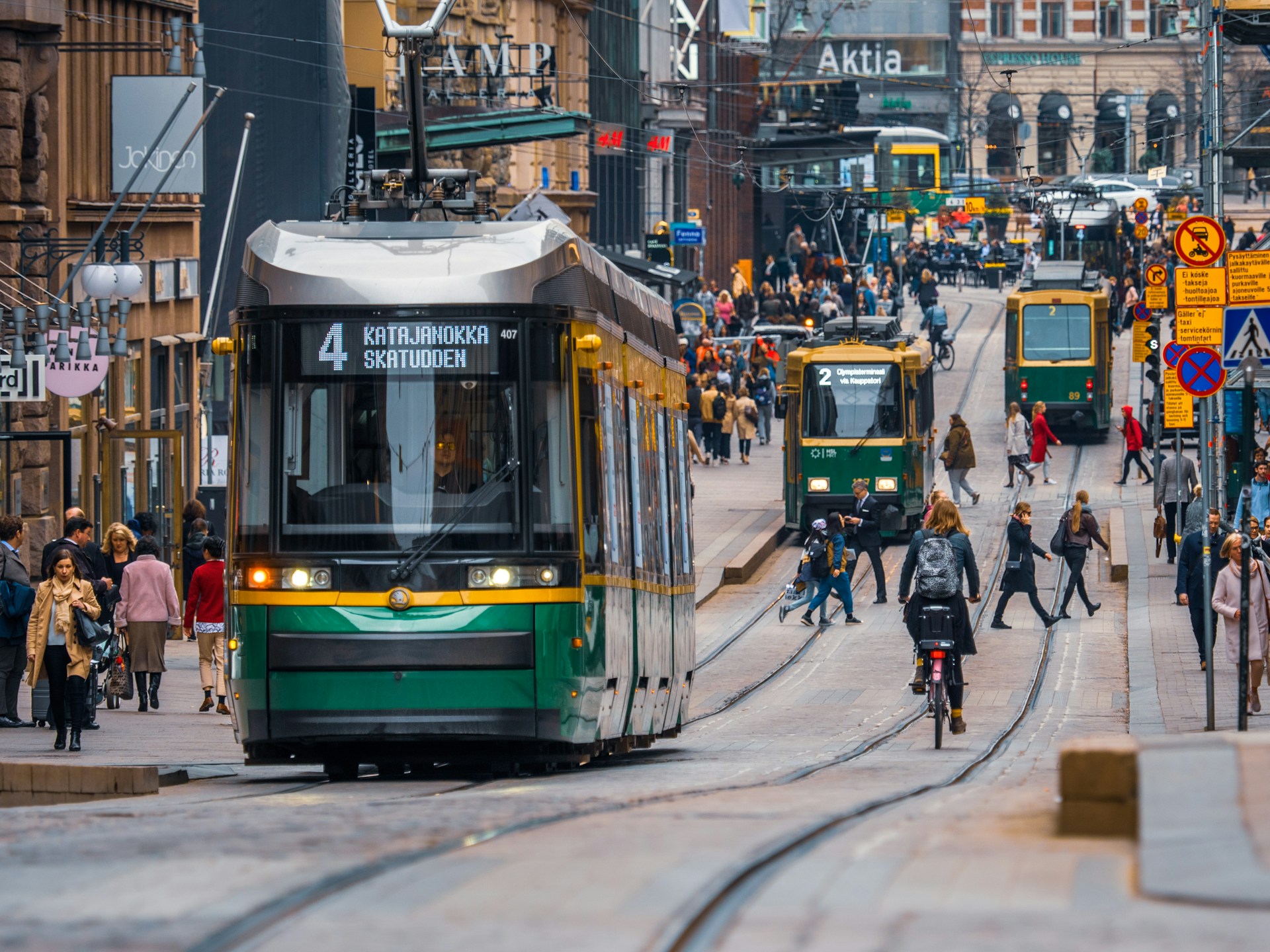
Mennääks sporalla? — Helsinki, where the tram is a spora and textbook Finnish meets the street. Photo by Tapio Haaja on Unsplash
Finnish has two languages (and you probably only know one)

Pip
Sep 30, 2026 · 6 min read
You've studied Finnish. You can conjugate verbs, decline nouns, and maybe even handle partitive case without crying. Then you turn on a Finnish TV show and understand... nothing.
Welcome to puhekieli — spoken Finnish — where everything you learned gets thrown in a blender.
The big picture: two Finnishes
Finnish has an unusually large gap between written language (kirjakieli) and spoken language (puhekieli). This isn't just accent or slang — it's systematic differences in grammar, vocabulary, and word forms that make spoken Finnish almost a separate dialect.
Your textbook teaches kirjakieli. Actual Finns speak puhekieli. Here's how to bridge the gap.
Why this matters
Here's the reassuring part before you dive in: spoken Finnish isn't random slang. It follows its own consistent rules — the same shifts happen every time, across the whole language. Once you learn the system, you can decode it. The sections below are that system.
You can absolutely get by in Finland with textbook Finnish — Finns will understand you perfectly. But understanding them requires recognizing these patterns. Start by listening for the pronoun shifts (mä, sä, se) and the -ksä question pattern. Once those click, the rest follows.
1. Pronouns: the great shrinkage
The first thing that throws learners off isn't vocabulary — it's pronouns. Every Finn you meet will be using forms your textbook never showed you. The classic moment: a Finn talks about their best friend and refers to them as se. In written Finnish, se means "it." You look around wondering if your language skills have somehow gotten worse. They haven't. It's completely normal. Just a little alarming the first time. Hän is still there — you'll see it in news articles and formal writing — but in everyday speech, se does the work.
| Written | Spoken (Helsinki) | Spoken (Eastern) | Spoken (Tampere) |
|---|---|---|---|
| minä | mä | mie | mää |
| sinä | sä | sie | sää |
| hän | se | se | se |
| me | me | myö | me |
| te | te | työ | te |
| he | ne | hyö | ne |
2. Words melting together
The question particle -ko/-kö is already doing a lot of work in written Finnish — it turns any statement into a yes/no question. In speech, it keeps going. It absorbs the pronoun sinä whole and comes out the other side barely recognizable. Tuletko sinä collapses into tuleksä — two words and six syllables reduced to one word and three. It's almost elegant, once you stop being horrified by it.
| Written | Spoken | Meaning |
|---|---|---|
| tuletko sinä | tuleksä | are you coming |
| menetkö sinä | meeksä | are you going |
| oletko sinä | ooksä | are you |
| tiedätkö sinä | tieksä | do you know |
The pattern: the -ko/-kö question ending absorbs the pronoun sinä and compresses into -ksä.
The same fusion happens with common conjunctions too. Sitten kun (when / once something happens) becomes sitku, and niin kuin (like / as) becomes niinku. No grammar rule required — they're just two words that got tired of being two words.
3. Sounds and letters that vanish
Spoken Finnish is ruthlessly efficient. Adjectives shed a syllable, possessives collapse, and consonants that seemed load-bearing in your textbook quietly disappear. There are four distinct things happening here, so let's go through them one at a time.
-inen adjectives lose the -i-:
- punainen → punanen (red)
- keltainen → keltanen (yellow)
- iloinen → ilonen (happy)
Possessive suffixes shrink:
- minun kirjani → mun kirja (my book) — the possessive suffix -ni disappears entirely
- sinun autosi → sun auto (your car)
Next: this is the one that trips up learners most. It looks like a typo when you first see it written down, but it's completely systematic — and more widespread than its reputation suggests. You'll hear it across casual urban speech nationwide, not just in Häme where the tradition is strongest. Once you start listening for it, you hear it everywhere.
The letter d disappears:
- tiedän → tiiän (I know)
- tehdä → tehä (to do/make)
- Lahdesta → Lahesta (from Lahti)
Final vowels drop in common words:
- pitäisi → pitäis/pitäs (should)
- olisi → olis (would be)
- voisitko → voisiksä or even voiksä (could you)
- kun → ku (when / because)

4. Verbs get casual
Verbs follow the same logic as everything else in puhekieli: trim everything that can be trimmed. The pattern affects most common verbs — and you've already seen one example above with ei ole → ei oo.
The negative verb simplifies:
- ei ole → ei oo (isn't / there isn't)
- en tiedä → en tiiä or emmä tiiä (I don't know) — varies by dialect
Common verbs have spoken forms:
| Written | Spoken | Meaning |
|---|---|---|
| tulla | tuu (imperative: tuu!) | to come |
| mennä | mee (imperative: mee!) | to go |
| sanoa | sanoo | to say |
| puhua | puhuu | to speak |
5. A survival phrase list
Finnish greetings vary wildly by region and who you're talking to — anywhere from Miten menee? to a simple No mitäs? ("well?") — so they resist a neat written/spoken mapping. The phrases below are where the gap is clearest. Knowing these signals to Finns that you've been paying attention to how they actually talk, not just how grammarians say they should.
| Written | Spoken | Meaning |
|---|---|---|
| En tiedä | Emmä tiiä / En tiiä | I don't know |
| Onko sinulla purukumia? | Onks sulla purkkaa? | Do you have chewing gum? |
| Minä menen kotiin | Mä meen kotii | I'm going home |
| Haluatko sinä kahvia? | Haluuks kahvii? / Haluuksä kahvii? | Do you want coffee? |
A word of warning: it goes deeper
Everything above is broadly understood across Finland. But step outside that, and things get regional fast.
In northern Finland you might hear "Talavella ylleensä kelekkaillaan" — which is regional Finnish for "Yleensä talvella kelkkaillaan" ("Usually in the winter we do snowmobiling"). The vowels shift, the stress moves, whole syllables rearrange.
In Helsinki, a text message might read "mennääx sporalla?" — -x standing in for the question particle -ks, and spora being Helsinki slang for tram. Don't look that up in any textbook.
The good news: Finns are used to being understood across dialects. You don't need to produce any of this — just don't panic when you encounter it.
Cheat sheet
Keep this handy while you're watching Finnish TV or listening to podcasts.
Pronouns: minä→mä, sinä→sä, hän→se
Question + pronoun fusion: -ko sinä → -ksä (tuleksä, meeksä, ooksä)
Sounds and letters: -inen→-nen, d vanishes (tiedän→tiiän), possessive suffixes dropped, final vowels drop (pitäisi→pitäis)
Common swaps: ei ole→ei oo, en tiedä→emmä tiiä/en tiiä
Tsemppiä opiskeluun! — Pip 🌿
Sources
- Hakulinen, Auli et al. Iso suomen kielioppi — VISK online (comprehensive Finnish grammar reference, in Finnish)
- Karlsson, Fred. Finnish: An Essential Grammar. Routledge, 2008 — Publisher link
- Uusi kielemme — Finnish grammar resource with spoken vs. written comparisons
Related posts
Want to practise what you've read?
Lingoberry gives you AI-powered translation, dictation, and speaking exercises — guided by Pip.
Try Lingoberry — it's freeComments
Join the conversation!
Log in to commentNo comments yet. Be the first to share!