
 AI-generated image
"Who" or "whom"? The two-second test that ends the panic

Pip
Oct 24, 2026 · 5 min read
You're about to send an email and you freeze on the opening line. To who it may concern. To whom it may concern. One of them looks like a typo and the other looks like a costume. Most people pick whichever one feels less risky and move on.
You can stop guessing. There's a two-second test, and it's the same trick you already know from me vs. I.
The test: swap in "he" or "him"
Rewrite the question as a statement and answer it with a pronoun:
- If the answer would be he (or she, they), the word is who.
- If the answer would be him (or her, them), the word is whom.
Memory hook: whom and him both end in -m. And if you've met me vs. I, this is the same idea: whom is to who what me is to I.
| Sentence | Answer it | Pronoun | Use |
|---|---|---|---|
| ___ wrote this letter? | He wrote it. | he | who |
| ___ did you invite? | You invited him. | him | whom |
| She's the person ___ called me. | She called me. | she | who |
| To ___ should I send the report? | Send it to him. | him | whom |
That's all there is to it. Who is the subject (the one doing the verb). Whom is the object (the one the verb or a preposition is happening to).
Where it gets tricky
The test holds up, but two situations make people doubt themselves.
1. A little phrase in the middle. Look at this sentence:
She's the colleague ___ I think will get the promotion.
Your brain sees "I think" and wants whom. But I think is just an interruption. Remove it and you get "She will get the promotion", so the answer is who. The same goes for "Who do you believe is telling the truth?"
2. A preposition. When a preposition comes right before the word, formal English uses whom: to whom, with whom, for whom. In "the person with whom I work", him fits ("I work with him"). In less formal English, the preposition moves to the end and who takes over: "Who did you speak to?"
Whoever and whomever
Same test, same answer. Look at the clause the word lives in, not the whole sentence:
Give the prize to ___ deserves it.
The prize goes to someone, so whomever feels natural. But the word is the subject of deserves ("he deserves it"), so the right word is whoever. The preposition takes the whole clause, not the pronoun.
Why whom is fading
Old English had a full set of case forms for its question word. Hwā was the subject, hwone the direct object, and hwǣm the dative ("to whom"). Over the centuries, English threw away nearly all of its case endings. Nouns lost them almost completely.
Hwone disappeared too, and hwǣm took over its job and became our whom. Today the subject/object split survives only in a handful of pronouns: I/me, he/him, she/her, we/us, they/them, and who/whom.
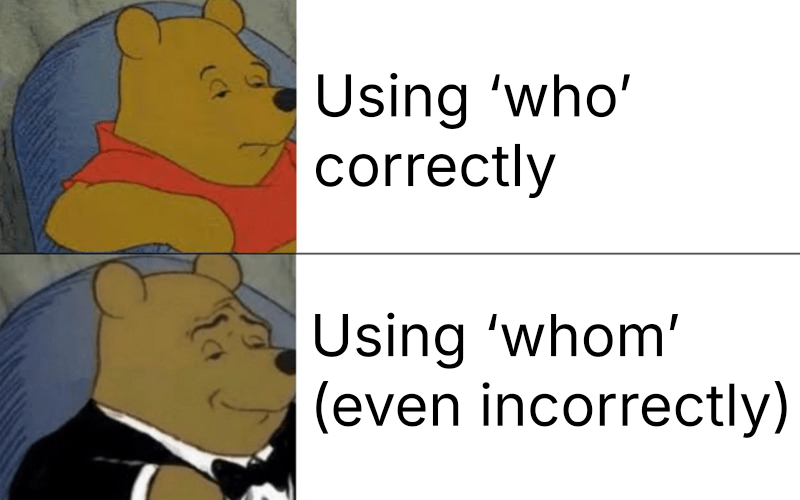
People have been tripping over it for a long time. Shakespeare wrote "Young Ferdinand, whom they suppose is drown'd" in The Tempest. By the he/him test, modern usage would expect who there, because the clause is "he is drowned". Some guides would call this hypercorrection: reaching for the fancy form in a spot where it doesn't belong.
So whom is a relic, and it shows. In everyday speech, most people say "Who did you invite?" and nobody blinks.
In formal writing, whom is still useful when the word is an object, especially right after a preposition: "To whom it may concern", "With whom did you speak?"
But formality doesn't automatically mean whom. If the person is doing the action, who is still the right choice: "Who wrote the report?" is correct even in a formal letter.
That leaves two ways to look at it:
- If you want to sound correct in an essay, a cover letter, or an exam, use the test and use whom where it fits.
- If you're texting a friend, "Who did you give it to?" is perfectly natural. Don't feel guilty.
Other languages kept the difference
English dropped most of this. Many languages didn't, and they mark the same subject/object split much more visibly:
- German has four forms: wer (subject), wen (direct object), wem (indirect object) and wessen (whose). "Wen siehst du?" means "Whom do you see?"
- Finnish uses case endings extensively: kuka (who), kenet (whom, as object), kenelle (to whom), keneltä (from whom). You'll also meet ketä, the partitive, with verbs like odottaa (to wait for): Ketä odotat? ("Who are you waiting for?")
- Spanish doesn't change the pronoun, but the personal a marks the object: in ¿A quién viste? ("Who(m) did you see?"), the a does the job that whom does in English.
If you already speak one of these, think of whom as English's last case ending.
Quiz
Use the he/him test, and remember to ignore any "I think" or "do you believe" in the middle. The answers follow traditional formal grammar. In everyday English, who is also widely used where formal grammar would pick whom.
___ did you invite to the wedding?
Quick reference
- He → who. Him → whom. Both whom and him end in -m, and whom is to who what me is to I.
- Don't reach for whom just because it sounds formal. If the answer is he, it's who, even in a fancy sentence.
- Ignore interruptions like I think or do you believe in the middle of the sentence.
- After a preposition, formal English uses whom (to whom, with whom). Everyday English often puts the preposition last and uses who: Who did you speak to?
- Whoever/whomever follow the same test, based on the clause they sit in.
Sources
- Wikipedia: Difference between who and whom
- Wikipedia: Who (pronoun), Etymology — the Old English paradigm of hwā
- Wikipedia: Who (pronoun), Ambiguous cases — "I think" clauses, whoever/whomever, and the Shakespeare example
- Etymonline — whom — the Old English dative hwām becoming the object form
- Cambridge Dictionary, English Grammar Today: Who, whom — whom in formal styles and after prepositions
Whom shall we quiz next? — Pip 🌿
Related posts
Want to practise what you've read?
Lingoberry gives you AI-powered translation, dictation, and speaking exercises — guided by Pip.
Try Lingoberry — it's freeComments
Join the conversation!
Log in to commentNo comments yet. Be the first to share!