
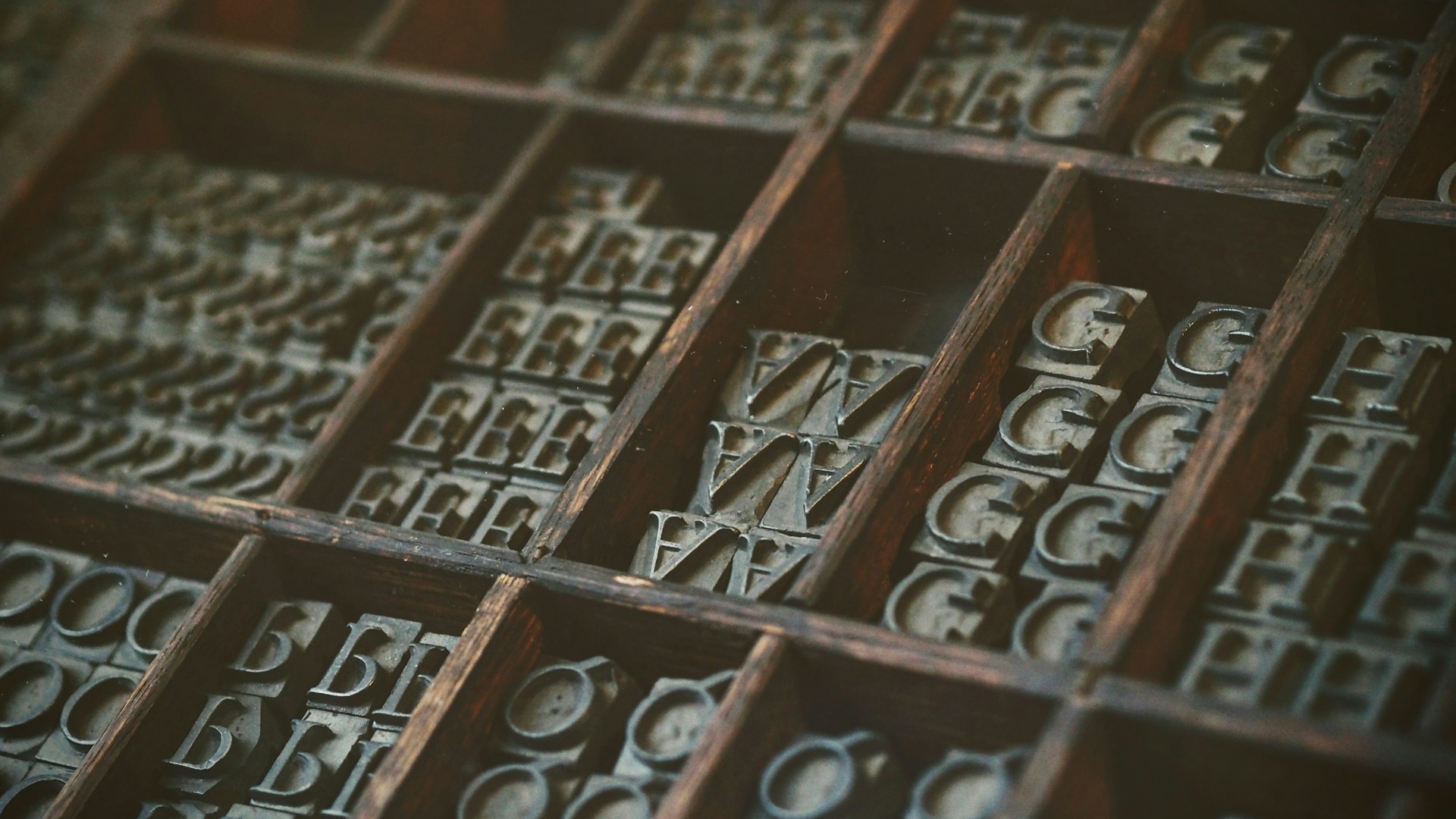
Photo by Natalia Y. on Unsplash
Why English spelling is a crime scene
 Pip · Sep 12, 2026 · 7 min read
If you've ever wondered why knight has a silent K, why cough, dough, through, and bough all end in -ough but rhyme with nothing, or why island has an S that nobody pronounces — you're looking at the aftermath of a thousand-year pileup.
English spelling wasn't designed. It accumulated, like geological strata. Five languages had a hand in it — Old English, Old Norse, Norman French, Latin, and Greek — and none of them cleaned up after themselves. Throw in some overenthusiastic Renaissance scholars, a few Flemish typesetters, and one of the most dramatic vowel shifts in linguistic history, and you get modern English: a language where ghoti could theoretically spell "fish."
How? Take the gh from enough (which sounds like F), the o from women (which sounds like short I), and the ti from nation (which sounds like SH). String them together: F-I-SH. The spelling is absurd, but each piece is borrowed from a real English word.
Here's the forensic report.
Act I: Old English (450–1066 AD) — when spelling made sense
Before all the chaos, English spelling was remarkably phonetic. The Anglo-Saxons wrote pretty much what they said. The word knight was spelled cniht, and you pronounced every letter — the hard C, the N, and the H as a guttural sound (like the ch in Scottish loch), all of it.
Same story with knee, knife, know. The KN- cluster was pronounced as two sounds. Gnaw had a hard G. Write had a full W (something like "writa"). English speakers hadn't yet decided that certain consonants were decorative.
Vowels were stable too. Each letter had one sound. Name would have been pronounced something like "NAH-meh." Time was "TEE-meh." What you saw was what you got.
Then the Normans arrived.
Act II: The Norman Invasion (1066) — French bureaucrats take over
 Photo by Vlad Ardeleanu on Unsplash
When William the Conqueror won the Battle of Hastings in 1066, he didn't just seize the throne. He installed a French-speaking aristocracy that ran the government, the courts, and the church for the next 300 years.
Old English didn't vanish — the peasants kept speaking it — but the people writing things down were Norman scribes who found English sounds baffling and English spelling provincial. So they "fixed" it.
The Old English letter cw looked too crude, so they swapped it for the more elegant French qu. Overnight, cwēn became queen.
The letter combination hw was reordered to wh, because that's how French scribes were taught to think about the sound. Hwæt became what.
And then there was the poor letter u. In the middle of a word, Norman scribes found u hard to read — too many up-and-down strokes (called minims) next to letters like n, m, and v. Their solution? Replace u with o when it sat near those tricky letters. That's why we write love, come, son, and wonder — words that, by any sensible rule, should have a u where the o is. The pronunciation stayed the same; the spelling changed to suit handwriting aesthetics.
The Normans also imported thousands of French words wholesale — beef, pork, court, judge, liberty — each bringing its own French spelling conventions. English vocabulary doubled, and so did its spelling inconsistencies.
Act III: The Great Vowel Shift (1400–1700) — the ground moves
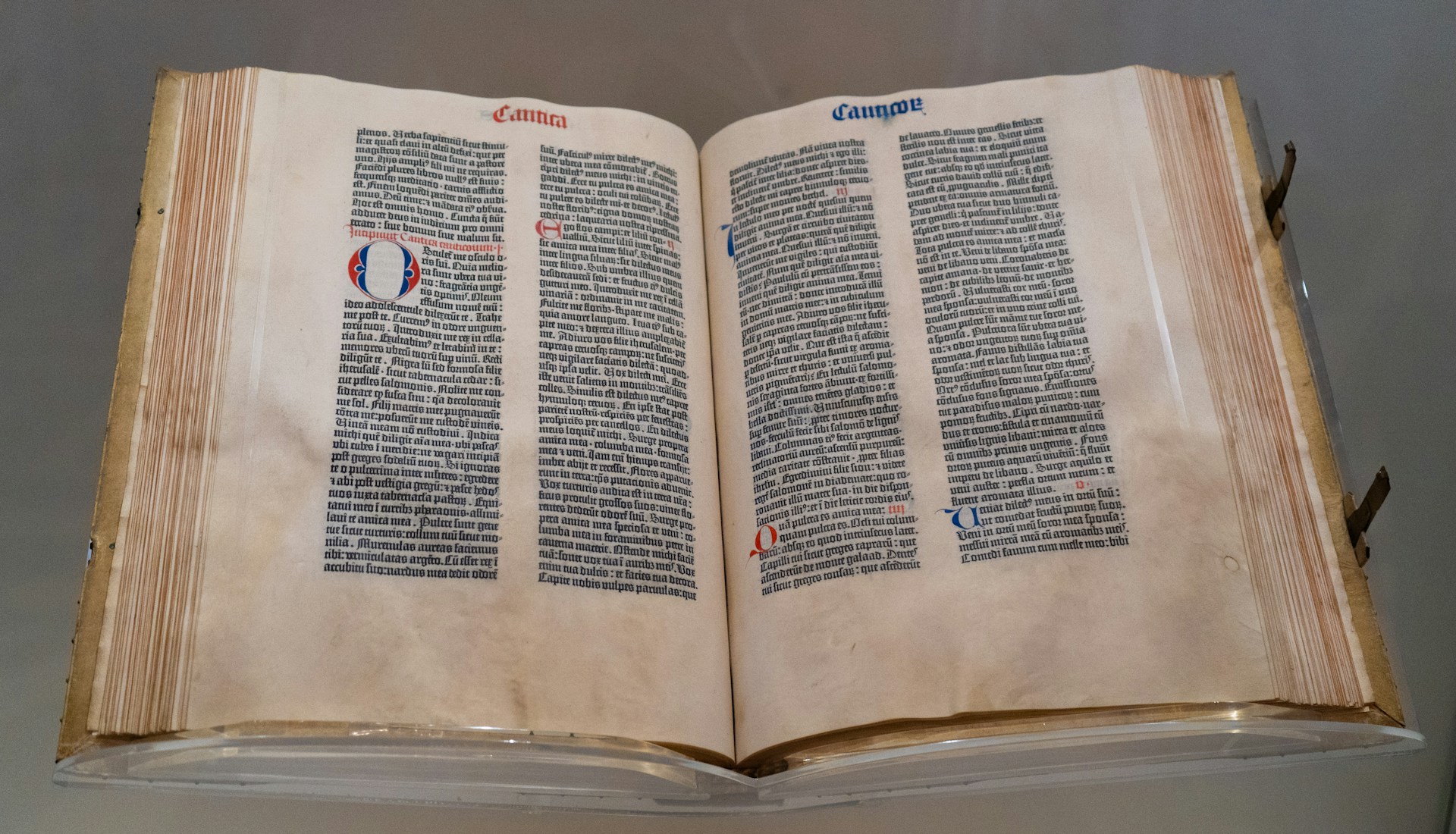 Photo by Simon Ray on Unsplash
Then, just as the dust was settling, English pronunciation underwent one of the most dramatic changes in recorded linguistic history: the Great Vowel Shift.
Between roughly 1400 and 1700, every long vowel in English moved up in the mouth. It's like someone reached into the language and cranked a dial one notch clockwise:
- The "ah" in name slid up to "ay" (NAH-meh → NAYM)
- The "ee" in bite became "eye" (BEE-teh → BAIT)
- The "oo" in house shifted to "ow" (HOOS → HOWSS)
Nobody planned this. Nobody voted. Over three centuries, speakers just... drifted. Linguists still argue about why. One theory blames the Black Death: the plague killed so many people that regional dialects mixed in unprecedented ways, destabilising the vowel system. Another blames prestige — London speech became the model to imitate, and the chase for status accelerated the shift.
What matters for spelling is the timing. The printing press arrived in England in 1476 — right in the middle of the Shift. William Caxton and the early printers had to pick a spelling for each word, and they mostly picked spellings that reflected how words sounded before the Shift finished. By the time people were saying name as "naym" and time as "time," the books already said NAME and TIME. The spelling froze; the pronunciation kept moving.
That's why English has so many "silent E" words. The E wasn't silent when the spellings were set — it marked a long vowel. The vowel shifted, the E stayed.
Act IV: The Renaissance scholars (1500s–1600s) — the Latin vandals
As if that weren't enough, 16th-century English scholars made things worse by "correcting" words to look more like their Latin or Greek origins — whether or not English speakers had ever pronounced those sounds.
Take debt. Middle English spelled it dette, borrowed from Old French dete. It came from Latin debitum, but nobody said the B. The Renaissance scholars, embarrassed that English didn't look scholarly enough, shoved the B back in. The B is still there. It's still silent.
Same story with doubt (from doute, "corrected" to match Latin dubitare), receipt (from receite, retrofitted with a P to honour Latin receptum), and salmon (given an L to match Latin salmo, which English had been happily ignoring for centuries).
The wildest case is island. The word has nothing to do with Latin. It's pure Germanic: Old English īegland (literally "water-land"), which became iland in Middle English. But English already had the word isle (borrowed from Old French, which got it from Latin insula), and some scholar decided iland should match its fancy French cousin. The S has been sitting there for 500 years, doing nothing.
Act V: The Flemish typesetters — foreign habits
Meanwhile, William Caxton's printing operation employed a lot of Flemish compositors — typesetters from the Low Countries. These men brought their native spelling habits with them.
The Dutch wrote gheest and gheestelyk with a GH- for the hard G sound, so when they set English type, gost became ghost. The same habit gave us ghastly (from gastly) and aghast. The H wasn't there before; it was added because that's how Flemish typesetters were trained to spell that sound.
The letter combination gh became a dumping ground for sounds that no longer existed. Words like night, light, thought, and daughter once had a guttural sound (like German ich or Scottish loch). By the 1500s, most English speakers had stopped making that sound — but the GH stayed on the page, a ghost of a ghost.
The -ough problem: a case study in chaos
Nowhere is the pileup clearer than in the infamous -ough words. All spelled the same. All pronounced differently:
- cough — "off"
- rough — "uff"
- bough — "ow"
- through — "oo"
- dough — "oh"
- thought — "aw"
- hiccough — once spelled hiccup, respelled to look like cough (then people couldn't figure out how to pronounce it)
These words all descend from Old English forms with the same guttural consonant — but dialects dropped the sound in different ways, and spelling standardised before anyone agreed on pronunciation. The result is seven words that rhyme with nothing, including each other.
Why didn't anyone fix it?
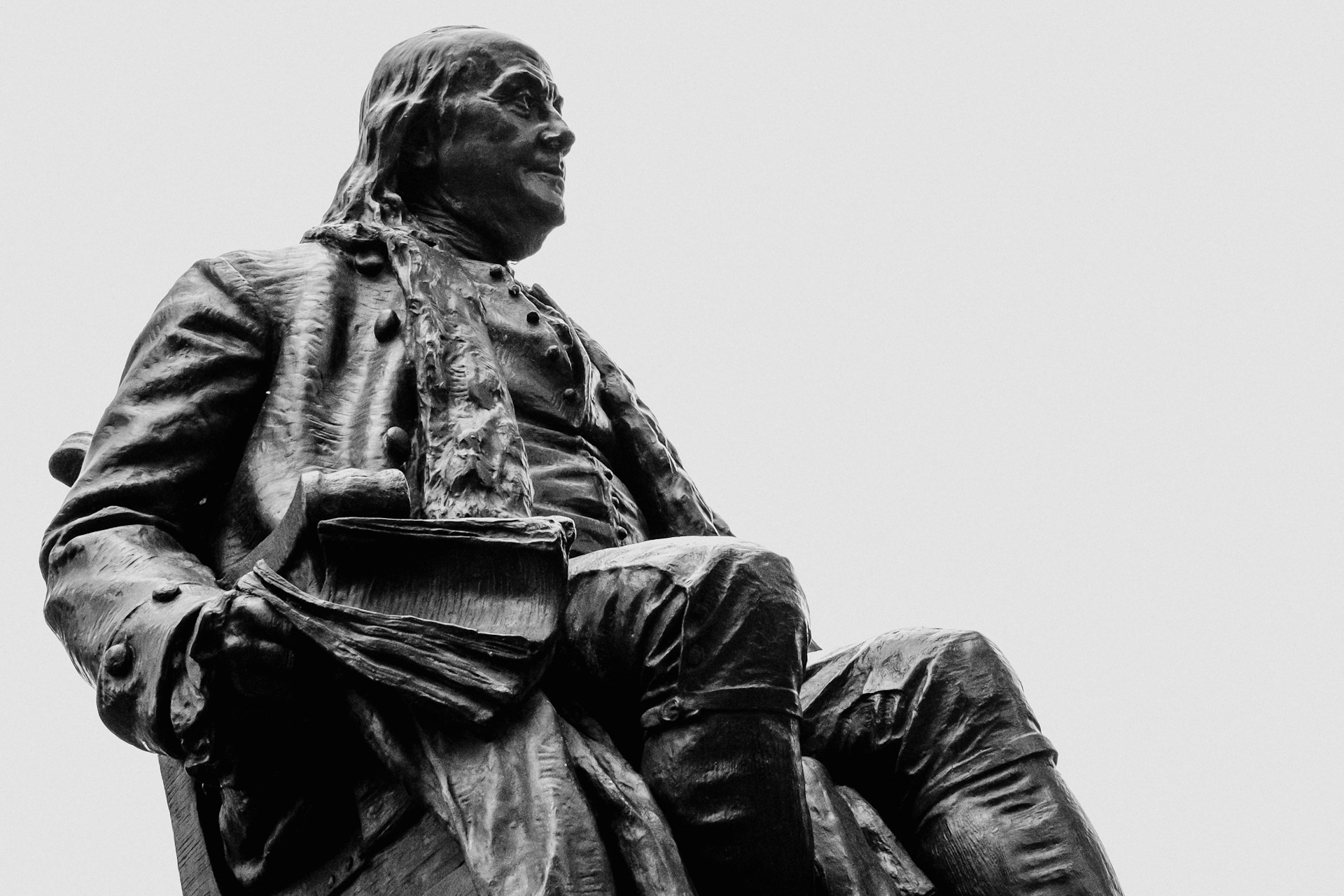 Photo by Peter Bryan on Unsplash
English has had reformers. Benjamin Franklin proposed a new alphabet in 1768. Noah Webster (of dictionary fame) simplified American spelling — dropping the U from colour, swapping -re for -er in center — but couldn't push through anything radical. George Bernard Shaw left money in his will for a new English alphabet; the Shavian script exists, but almost nobody uses it.
The problem is inertia. Four hundred years of printed books, legal documents, and cultural heritage are locked in the current system. Any "rational" respelling would make the entire English literary canon look foreign overnight. So we keep the crime scene intact — and linguists like David Crystal (Spell It Out) and John McWhorter (Our Magnificent Bastard Tongue) help us understand why it ended up this way.
How to make peace with it
If you're learning English — or just baffled by it — here's the good news: the chaos isn't random. It's archaeological. Each weird spelling is a fossil. Once you know which layer it came from, the patterns start to emerge:
- Silent K and G? Old English. Those sounds were once spoken.
- QU instead of CW? Norman scribes.
- O pronounced like U (love, come)? Handwriting aesthetics.
- Silent B in debt, doubt? Renaissance Latin snobbery.
- GH doing nothing (ghost, night)? Flemish typesetters and dead guttural sounds.
- -OUGH chaos? Regional dialects frozen mid-shift.
English spelling is a crime scene, yes — but it's also an open archive. Every silent letter is a witness. Every weird exception is a story. And now you know where the bodies are buried.
Until next time! — Pip 🌿
Sources
- Wikipedia — Great Vowel Shift
- Wikipedia — Middle English
- Wikipedia — Norman Conquest of England
- Wikipedia — English Orthography
- Etymonline — entries for knight, island, debt, ghost
- The History of English Podcast — historyofenglishpodcast.com
Related posts
Want to practise what you've read?
Lingoberry gives you AI-powered translation, dictation, and speaking exercises — guided by Pip.
Try Lingoberry — it's freeComments
Join the conversation!
Log in to commentNo comments yet. Be the first to share!