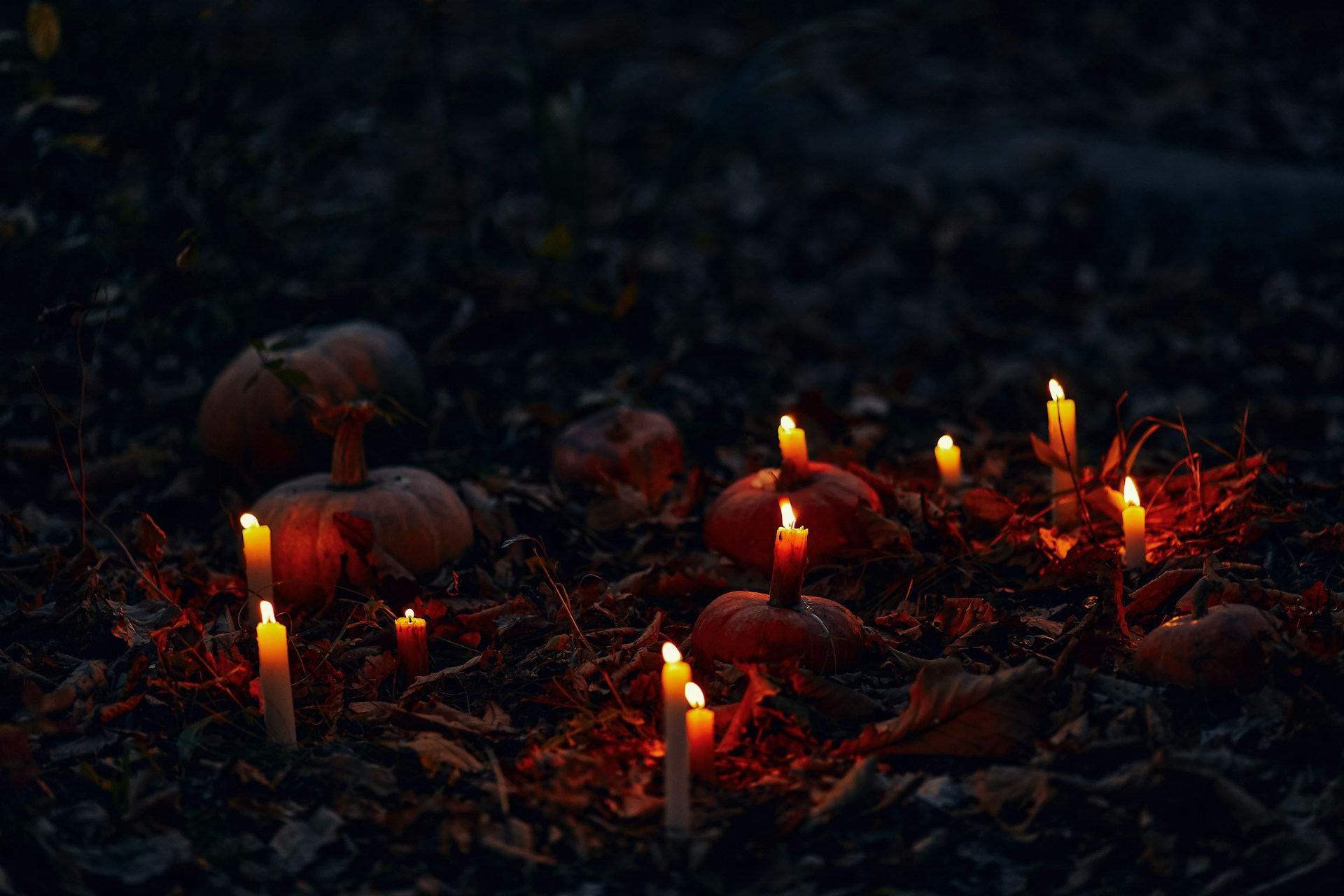
Pumpkins lying on the ground with autumn leaves and burning candles around. Photo by Олег Мороз on Unsplash
Kekri: Finland's forgotten Halloween (and the words that come with it)

Oct 30, 2026 · 9 min read
Boo! Did I scare you? No? Good. I'm a lingonberry, I'm more "cosy" than "spooky".
Long before Finnish children started carving pumpkins and asking for sweets, Finland had a rather different autumn tradition. Imagine masked visitors arriving at your door, demanding food and drink, and threatening your oven if you refused. Welcome to Kekri!
Let's take a stroll through the dark season together, with plenty of new words in our basket.
What was Kekri?
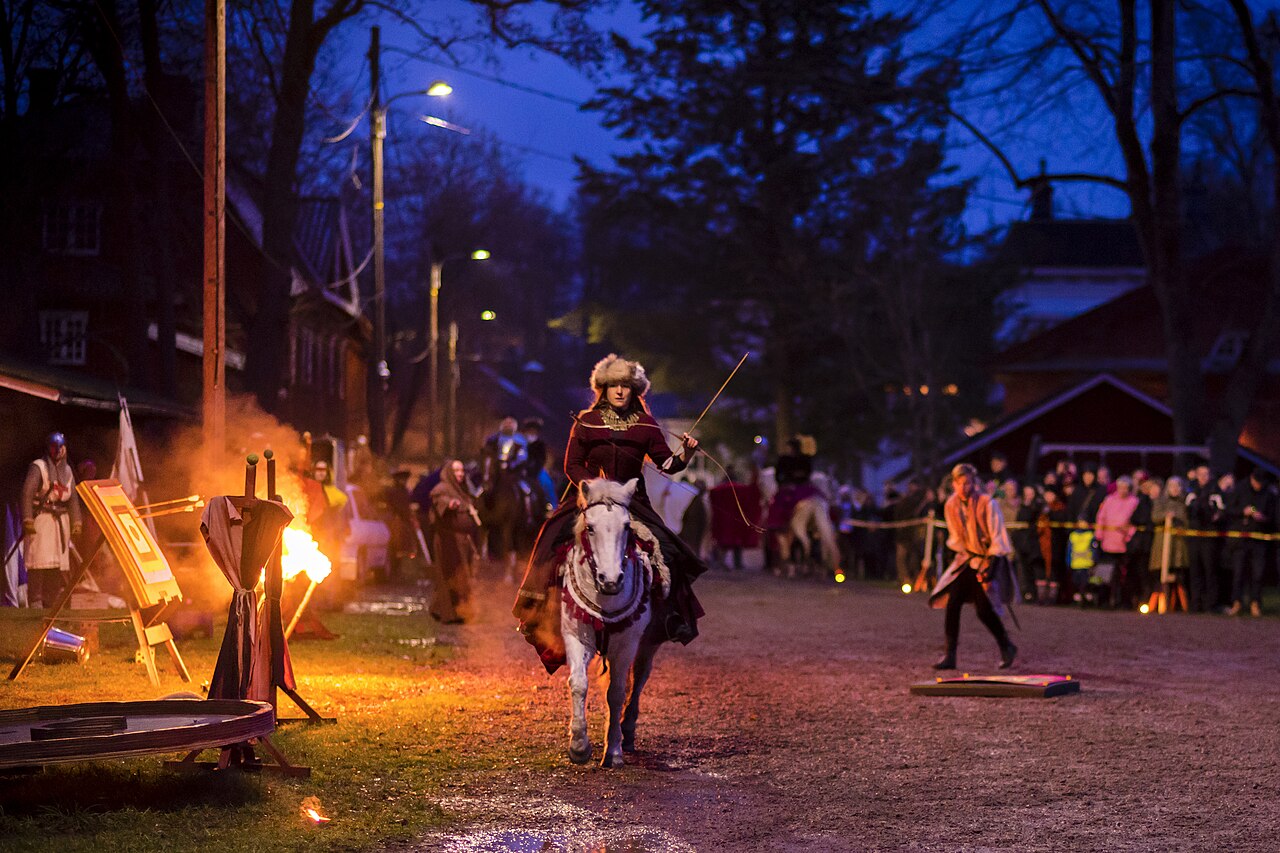
Kekri was a traditional Finnish harvest festival. It marked the end of the farming year: the crops were in, the animals came home from pasture, and it was time to feast before the long, dark winter. The timing varied from place to place and farm to farm, but it usually fell somewhere between Michaelmas in late September and pyhäinpäivä (All Saints' Day) in early November.
For a long time, Kekri was the countryside's most important celebration, while Christmas was more of a city festival. There's even an old proverb about it: Talonpojilla kekri, herrain joulu, "Kekri for the farmers, Christmas for the gentry". The word itself first appears in writing in Mikael Agricola's Psalter of 1551.
Kekri was also a threshold moment. The old year was over, the new one hadn't started, and people believed that the spirits of the dead were close. In some places, the household heated the sauna for the ancestors and left them food before the living took their turn. Sound familiar? It's the same "thin veil" feeling that Halloween has, with a lot less plastic and a lot more roast lamb.
Three autumn traditions, one dark season
Over time, Kekri faded as people moved to towns, and many of its customs drifted into Christmas. In the 1800s it also merged with the Christian pyhäinpäivä, the remembrance day for the dead, which since 1955 has been celebrated on a Saturday between 31 October and 6 November. Halloween arrived much later, from the United States in the 1980s, and children and students have taken it up most enthusiastically.
So Finland now has three autumn traditions living side by side:
| Tradition | What it is | Typical customs |
|---|---|---|
| Kekri | Old harvest festival, the turn of the farming year | Feasting, masked visitors, folk beliefs |
| Pyhäinpäivä | Christian day of remembrance for the dead | Candles and heather at the cemetery |
| Halloween | Modern import, rooted in the Celtic Samhain | Costumes, pumpkins, trick or treat |
Kekri and Halloween aren't strangers. Both grew out of European farming culture and folk belief, and both are about the turn of the year and the dead. Finnish broadcaster Yle even called Kekri "Halloween's little cousin" (halloweenin pikkuserkku). Lovely!
Finland's own trick or treat
Here's the part that surprises most people. In many places, people dressed up as Kekri creatures and went from house to house demanding food and drink. The visitors were called kekrittäret, and the star of the show was the kekripukki, the "Kekri goat". Kekri was a time when everything was upside down, so men could dress as women and women as men.
The costumes varied from region to region. One account from Iisalmi, written down in 1909, describes a goat made of a man in an inside-out fur coat, with a second coat over his head and the sleeve stretched out like a long neck. An axe blade stuck out of the sleeve, a pair of shears made the beak and spoons were the ears, and the goat hopped around scaring the children. Other accounts mention horns made from spoons or shears and masks of birch bark.
And at the door? One account from Kuopio parish, written down in 1936, records the question visitors asked:
Köyriä vai uunia?
(Köyri is a dialect form of kekri.) Literally, "Kekri or the oven?" In other words, "Do you have something for us?" The visitors expected food and drink. If the household had nothing to offer, the oven got smashed. In another account, early visitors threatened to topple the oven unless they got coffee. That's trick or treat with real stakes, and the best oven-based negotiation in Finnish history.
According to Finnish Wikipedia, Kekri lanterns were carved from a nauris (turnip), not a pumpkin. They gave very little light, so people jokingly nicknamed them kitupiikki. A kitupiikki is actually a miser, so it's a cheeky name for a lantern that was stingy with its light.
Kekri also has a modern revival: in Kajaani, a big kekripukki is burned in the middle of the river at the end of the Kekri market.
Where does the word come from?
Honestly? Nobody knows for certain. The Finnish Literature Society (SKS) says that the history of Kekri and the origin of its name aren't known exactly. One hypothesis links kekri to a very early Indo-Iranian word related to Sanskrit cakra, "wheel", which would fit a word meaning "the turn of the year". That's a lovely image, but treat it as a theory, not a fact. Etymology detectives are welcome to dig deeper, and I've left a few starting points at the bottom.
Your autumn vocabulary basket
Here are the words you'll want for talking about Kekri, pyhäinpäivä and Halloween in Finnish:
Autumn and the harvest
- kekri: the old harvest festival
- sato: harvest, crop
- syksy: autumn
- pimeä: dark
Folklore and Halloween
- kekripukki: Kekri goat, a masked, horned visitor
- kummitus: ghost
- noita: witch
- kepponen: prank, practical joke
- karkki: sweet, candy
Things and places
- kynttilä: candle
- hauta: grave
- pyhäinpäivä: All Saints' Day
- nauris: turnip
- kurpitsa: pumpkin
- uuni: oven
- kestitys: hospitality, food and drink for guests
Today's Halloween phrase is karkki vai kepponen? ("Candy or a trick?"). It's a modern borrowing, but now you know its great-great-grandparent, köyriä vai uunia? Finland has an Easter version of door-to-door visiting too, called virpominen, where children visit neighbours with decorated willow twigs. Same idea, different season, and much more pussy willow.
A tiny grammar bite: karkki and karkkia
Did you spot karkkia in the dialogue below? Karkki is "a sweet", the basic form. Karkkia is the partitive, which Finnish uses for "some" or an unspecified amount: Lapset keräävät karkkia means "The children are collecting (some) sweets". You'll meet the partitive everywhere, so it's worth getting friendly with it.
Compound words: Finnish loves a bundle
Finnish builds new words by sticking old ones together. Halloween is a perfect playground:
- kurpitsa + lyhty (lantern) = kurpitsalyhty, a jack-o'-lantern
- nauris + lyhty = naurislyhty, a turnip lantern
- kummitus + puku (costume) = kummituspuku, a ghost costume
- hauta + kynttilä = hautakynttilä, a grave candle
Notice that the last word of the compound tells you what the thing is. A kurpitsalyhty is a kind of lantern, not a kind of pumpkin. Once you spot the pattern, you can decode a lot of long Finnish words.
A spooky little dialogue
Two friends are planning a Halloween evening. Click "Show translations" if you need a hand.
Halloween plans
Aino
Hei Eero! Tuletko huomenna meille? Teemme kurpitsalyhtyjä.
Hi Eero! Are you coming over tomorrow? We're making pumpkin lanterns.
Eero
Kyllä tulen! Onko sinulla jo asu?
Yes, I'm coming! Do you already have a costume?
Aino
On. Olen noita. Entä sinä?
I do. I'm a witch. And you?
Eero
Minä olen kummitus. Lapset keräävät karkkia illalla.
I'm a ghost. The children will collect sweets in the evening.
Aino
Hienoa! Sytytetään sitten kynttilä kekrin kunniaksi.
Great! Then let's light a candle in honour of Kekri.
Eero
Hyvä idea. Vanhaan aikaan lyhty tehtiin nauriista.
Good idea. In the old days, the lantern was made from a turnip.
Aino
Ja kekripukki huusi ovella ”Köyriä vai uunia?”
And the Kekri goat shouted at the door, "Köyri or the oven?"
Eero
Minä antaisin mieluummin karkkia!
I would rather give out sweets!
Can you explain Kekri in Finnish?
Here are three sentences you can take away and use:
- Kekri on vanha suomalainen sadonkorjuujuhla. Kekri is an old Finnish harvest festival.
- Sitä vietettiin syksyllä sadonkorjuun jälkeen. It was celebrated in autumn, after the harvest.
- Ihmiset söivät hyvin, pukeutuivat naamioihin ja juhlivat. People ate well, wore masks and celebrated.
Try changing a word or two and making them your own. That's how phrases turn into real Finnish!
Common mix-ups
- Kekri is not the Finnish word for Halloween. Halloween is just halloween in Finnish. Kekri is its own, older festival.
- Pyhäinpäivä is not spooky, and it isn't Finland's Day of the Dead. It's a quiet Christian day of remembrance, with candles and heather at the cemetery. Lovely, but a very different mood from costumes and sweets.
- Don't mix up kummitus and noita. A kummitus is a ghost; a noita is a witch. One floats, the other flies.
- Kekripukki and Joulupukki have a shared history. The Finnish name of Santa Claus, Joulupukki ("Yule goat"), has historical connections with older goat figures such as the kekripukki and the nuuttipukki. Early Finnish Christmas visitors were often rather different from today's friendly, red-coated Santa!
Quick reference
| Finnish | English |
|---|---|
| kekri | old harvest festival |
| pyhäinpäivä | All Saints' Day |
| kekripukki | Kekri goat (masked visitor) |
| köyriä vai uunia? | Kekri or the oven? |
| karkki vai kepponen? | trick or treat? |
| naurislyhty | turnip lantern |
| kurpitsalyhty | jack-o'-lantern |
| hautakynttilä | grave candle |
Try it yourself
What does sato mean?
A little takeaway
Whether you carve a pumpkin, a turnip, light a candle on a grave or just put a lantern in the window, the dark season is a lovely time to practise Finnish. Try describing your autumn evening in three sentences using today's words. If you can write kurpitsalyhty without blinking, you're doing wonderfully.
Sources
- Finnish Literature Society (SKS), Tietävä: Kekri, pyhäinpäivä ja halloween — history of the three traditions and the origin of the name
- Finnish Literature Society (SKS), Tietävä: Lisää kekrin perinteitä — archive accounts of the kekripukki, kekrittäret and "Köyriä vai uunia?"
- Kekri.fi: Kekri, the autumn harvest festival
- Wikipedia (Finnish): Kekri — turnip lanterns, the Kajaani tradition and the etymology hypothesis
- Wikipedia (Finnish): Joulupukki — origin of the name
- Wikipedia: All Saints' Day
Hyvää syksyä! — Pip 🌿
Related posts
Want to practise what you've read?
Lingoberry gives you AI-powered translation, dictation, and speaking exercises — guided by Pip.
Try Lingoberry — it's freeComments
Join the conversation!
Log in to commentNo comments yet. Be the first to share!