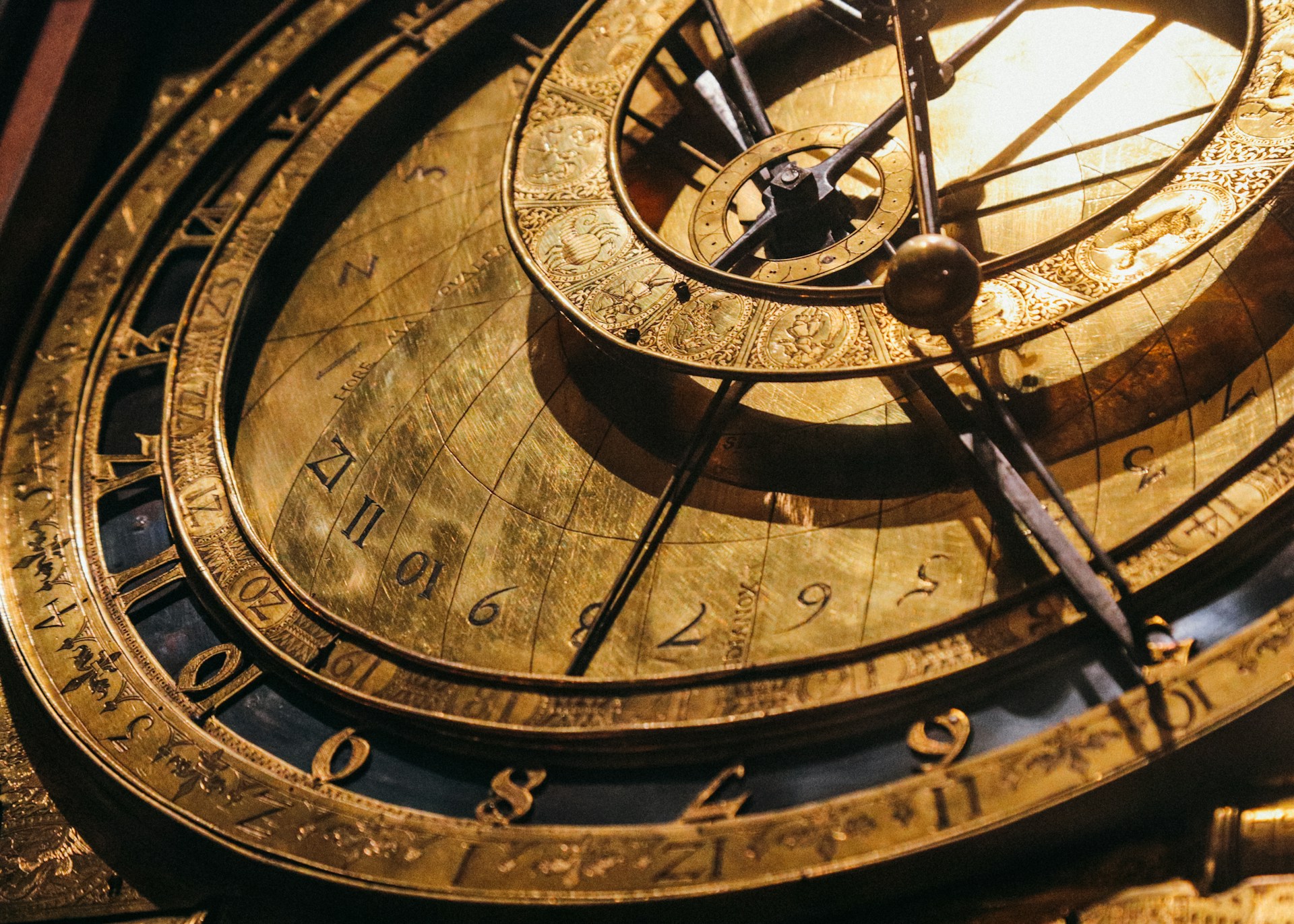
Photo by Alexey Savchenko on Unsplash
Where do the weekday names come from?

Pip
Sep 6, 2026 · 8 min read
A little while ago we followed the month names back to a Roman calendar that started in March, and found September still stubbornly meaning "seventh" two and a half thousand years after it stopped being the seventh month (if you missed it: September is lying to you).
The days of the week hide a story that is just as strange — but this one is a collision of two mythologies. Say the English weekdays out loud and you are quietly invoking Norse gods: Tiw, Woden, Thor, Frigg. Say the Spanish or French ones and you are invoking Roman ones: Mars, Mercury, Jupiter, Venus. They are the same seven days, named twice, by two different pantheons — and then partly overwritten by the Church.
Here is how that happened.
First, why seven?
There is nothing obvious about a seven-day week. Months roughly track the moon, years track the sun, but seven days track nothing astronomical. So where did it come from?
The answer is Babylon. The seven-day week can be traced to ancient Mesopotamia, where the number seven was sacred — and, conveniently, there were exactly seven "wandering stars" visible in the sky with the naked eye: the Sun, the Moon, and the five planets Mars, Mercury, Jupiter, Venus, and Saturn. One heavenly body, one day.
Rome picked up this seven-day cycle in late antiquity and ran it alongside its own older eight-day market week for a while, before Emperor Constantine made the seven-day week official in AD 321. Each day took the name of its planet, and each planet already carried the name of a god. That double layer — planet named for god, day named for planet — is the key to everything that follows.
The strange order (and a 1,900-year-old puzzle)
Here is something worth pausing on. If you list the planets by how the ancients ordered them in the sky — slowest-moving and most distant first — you get:
Saturn, Jupiter, Mars, Sun, Venus, Mercury, Moon.
But the days of the week do not follow that order. They go Sun, Moon, Mars, Mercury, Jupiter, Venus, Saturn. Around 100 AD, the Greek writer Plutarch already found this odd enough to ask, in a now-lost essay, why the days run in a different order from the planets themselves.
The answer is a delightful bit of ancient astrology called planetary hours. Each of the 24 hours of a day was thought to be "ruled" by a planet, cycling through that sky-order (Saturn, Jupiter, Mars, Sun, Venus, Mercury, Moon, then back to Saturn). Whichever planet ruled the first hour gave its name to the whole day.
Now do the counting. Start a day ruled by the Sun. Run the cycle through all 24 hours, and the 25th hour — the first hour of the next day — lands on the Moon. Count another 24, and you land on Mars. Then Mercury, Jupiter, Venus, Saturn. The weekday order isn't a mistake at all: it's what you get when you skip through a seven-planet list twenty-four hours at a time. The "wrong" order is actually a hidden sum — a little like those month names that are "wrong" only because they're counting from a year that no longer starts where it used to.
The Roman days, and the Romance languages
In Latin the days were, plainly, the days of the planets:
- diēs Sōlis — day of the Sun
- diēs Lūnae — day of the Moon
- diēs Mārtis — day of Mars
- diēs Mercuriī — day of Mercury
- diēs Iovis — day of Jupiter
- diēs Veneris — day of Venus
- diēs Sāturnī — day of Saturn
If you are learning Spanish, French or Italian, five of those are almost free vocabulary, because the Roman gods are still sitting there in the middle of the week: Spanish martes, miércoles, jueves, viernes; French mardi, mercredi, jeudi, vendredi; Italian martedì, mercoledì, giovedì, venerdì. Mars, Mercury, Jupiter and Venus, every single week.
But the two ends of the week were rewritten by Christianity. Sunday stopped being the Sun's day and became diēs Dominicus, "the Lord's Day" — hence Spanish domingo, French dimanche, Italian domenica. And Saturday was named for the Jewish Sabbath (diēs Sabbatī) — hence Spanish sábado, Italian sabato, and French samedi.
Portuguese: the language that deleted the gods
Portuguese learners will already have noticed something is off, because Portuguese weekdays look nothing like the others. They are segunda-feira, terça-feira, quarta-feira, quinta-feira, sexta-feira — literally "second," "third," "fourth," "fifth" and "sixth." No Mars, no Jupiter, no Venus. Just numbers.
That is the work of one man: Saint Martin of Braga, a sixth-century bishop who objected to naming the days after pagan gods and decided the faithful should number them instead (the feiras). Most of the Romance world ignored him. Portuguese — almost alone — kept the reform. It hangs on only to domingo (the Lord's Day) and sábado (the Sabbath) at the two ends, exactly the two days the Church had already renamed. So Portuguese is the one big Romance language where, if you want to say "Tuesday," you don't reach for a god. You count.
The Germanic detour: why English looks nothing like Spanish

So why does English — Tuesday, Wednesday, Thursday — look nothing like martes, miércoles, jueves? Because somewhere around the first century AD, the Germanic peoples borrowed the Roman week but swapped the Roman gods for their own closest equivalents. Scholars call this interpretatio germanica — roughly, "the local translation." God for god:
- Tuesday — Old English Tīwesdæg, the day of Tiw (Norse Týr), a war god, standing in for Mars, the Roman god of war.
- Wednesday — Wōdnesdæg, the day of Woden (Odin), standing in for Mercury. Both were gods of eloquence and magic — and, tellingly, both were psychopomps, guides who lead the souls of the dead onward.
- Thursday — Þūnresdæg, the day of Thor (whose name simply means "thunder"), standing in for Jupiter, the Roman thunder god. You can still hear it in German Donnerstag ("thunder's day"), Swedish torsdag, and even Finnish torstai.
- Friday — Frīgedæg, the day of the goddess Frigg, standing in for Venus, the goddess of love.
Sunday and Monday needed no translation — the Germanic peoples kept the Sun and the Moon, which is why English (unlike Spanish or French) still openly says "Sun-day" and "Moon-day."
Saturday: the day nobody could translate
And then there is Saturday — the one day that breaks the whole tidy scheme. When the Germanic peoples went looking for a local god to stand in for Saturn, they couldn't find one. There was no obvious Norse equivalent. So English simply gave up and kept the Roman god: Saturday is still, transparently, "Saturn's day" — the only day in English that honours a Roman deity rather than a Norse one.
The Scandinavians solved the problem differently. Rather than borrow a foreign god, they named the day after what people actually did on it: Old Norse laugardagr, "washing day." That is why Swedish lördag, Danish and Norwegian lørdag all quietly mean bath day — a reminder that Saturday was, once, the day you took your weekly wash.
The odd ones out: "mid-week"
A couple of the languages Pip teaches in went their own way on Wednesday. German replaced Woden entirely with Mittwoch — "mid-week" — and Finnish did exactly the same with keskiviikko, also "mid-week." (Finnish is a happy magpie here: torstai is Thor, perjantai is Frigg's Friday, but Wednesday is just the middle of the week.) German also tucked the Sabbath into Saturday as Samstag.
Seeing it all at once
Here is the whole week across the languages Pip teaches — the Roman god in the second column is the thread that ties most of them together:
| English | Roman day / god | Spanish | French | Italian | Portuguese | German | Swedish |
|---|---|---|---|---|---|---|---|
| Sunday | Sun (Lord's Day) | domingo | dimanche | domenica | domingo | Sonntag | söndag |
| Monday | Moon | lunes | lundi | lunedì | segunda-feira | Montag | måndag |
| Tuesday | Mars | martes | mardi | martedì | terça-feira | Dienstag | tisdag |
| Wednesday | Mercury | miércoles | mercredi | mercoledì | quarta-feira | Mittwoch | onsdag |
| Thursday | Jupiter | jueves | jeudi | giovedì | quinta-feira | Donnerstag | torsdag |
| Friday | Venus | viernes | vendredi | venerdì | sexta-feira | Freitag | fredag |
| Saturday | Saturn (Sabbath) | sábado | samedi | sabato | sábado | Samstag | lördag |
Read across any row and you can watch the history happen: the Latin god surviving in the middle of the week, the Christian rewrite at the two ends, Portuguese counting instead of naming, German and Scandinavian doing their own thing entirely.
How to actually use this
- Spanish, French, Italian: learn the four midweek gods once — Mars, Mercury, Jupiter, Venus — and Tuesday through Friday come almost for free across all three languages.
- Thursday is Thor's day. That single fact anchors torsdag, Donnerstag and torstai in one go.
- Sábado/samedi = Sabbath; domingo/dimanche/domenica = the Lord's Day. Two ends of the week, two pieces of the Christian calendar. You'll never mix them up again.
- Portuguese: stop hunting for gods. Count. Segunda to sexta, with sábado and domingo on the weekend.
The short version
- The seven-day week came from Babylon, built on the seven "planets" you can see with the naked eye, each named for a god.
- The order of the days isn't random — it falls out of "planetary hours," counting through the planets twenty-four hours at a time.
- Romance languages kept the Roman gods midweek, but swapped in the Lord's Day (Sunday) and the Sabbath (Saturday). Portuguese went further and numbered the days.
- English and the Germanic languages re-cast the Roman gods as Norse ones — Mars→Tiw, Mercury→Woden, Jupiter→Thor, Venus→Frigg — via interpretatio germanica.
- Saturday is the odd one out: no Norse Saturn, so English kept the Roman god while Scandinavia settled for "washing day."
Two mythologies, one calendar, and a whole week of history hiding in the words you say without thinking. Not bad for seven little words.
Hasta la próxima! — Pip 🌿
Sources
- Wikipedia — Names of the days of the week
- Wikipedia — Interpretatio germanica
- Wikipedia — Planetary hours
- Wikipedia — Week
- Wikipedia — Saint Martin of Braga
- Merriam-Webster — Etymologies for Every Day of the Week
- Britannica — Week
- Etymonline — Saturday · Wednesday
Related posts
Want to practise what you've read?
Lingoberry gives you AI-powered translation, dictation, and speaking exercises — guided by Pip.
Try Lingoberry — it's freeComments
Join the conversation!
Log in to commentNo comments yet. Be the first to share!