
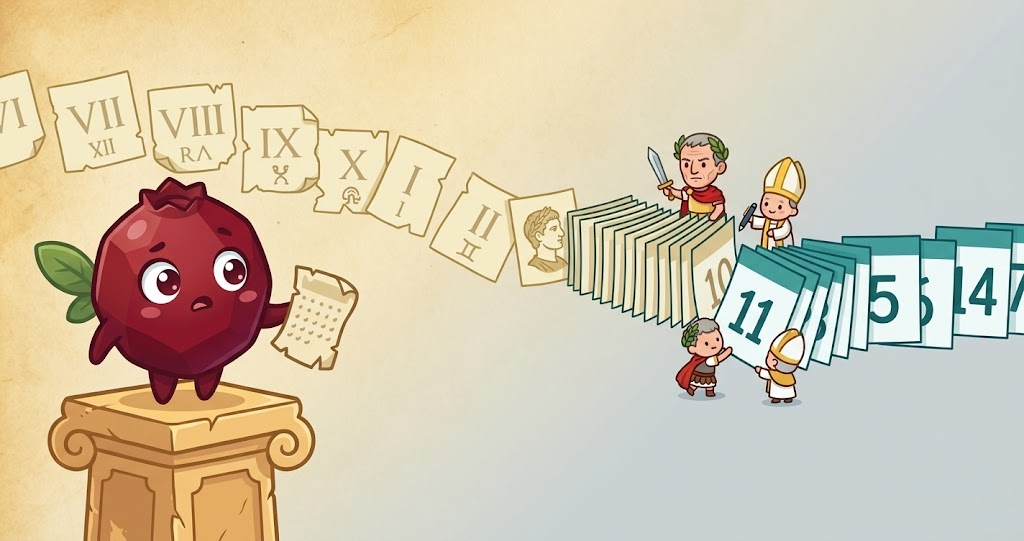
 AI-generated image
September is lying to you — and so are October, November, and December

Pip
Aug 5, 2026 · 8 min read
Look at the word September. Really look at it. Hidden right there in the first syllable is septem — Latin for seven. October? Octo, eight. November? Novem, nine. December? Decem, ten.
September is the ninth month of the year. It has been the ninth month of the year for over two thousand years. And its name still says seven.
This is not a typo. It is the fossil record of a calendar that was built in pieces, patched by kings, hijacked by politicians, and eventually overhauled by a dictator who had to invent an 80-day bonus year to fix the mess. Our months carry these scars, and once you see them, you cannot unsee them.
It started with ten months and a shrug
Around 753 BC, the legendary first king of Rome, Romulus, organised the year into ten months. The year began in March — Martius, named for Mars, the god of war, because that was when military campaigns resumed after winter.
The year looked like this:
- Martius (March) — Mars, god of war
- Aprilis (April) — from aperire, "to open" (think spring flowers opening)
- Maius (May) — Maia, earth goddess, patroness of growth
- Junius (June) — Juno, goddess of marriage
- Quintilis — literally "the fifth"
- Sextilis — "the sixth"
- September — septem, seven ✓
- October — octo, eight ✓
- November — novem, nine ✓
- December — decem, ten ✓
And then: nothing. Winter simply did not have months. The Roman government and military went dormant, crops did not grow, and the Romans apparently decided that a stretch of grey, cold days did not deserve names.
The numbered months — September through December — were correctly numbered at this point. That is the important thing to note. The problem came later.

A second king decides winter deserves a name
Around 713 BC, Romulus's successor, Numa Pompilius, looked at that nameless winter gap and found it untidy. He added two months to fill it:
- Januarius (January) — named for Janus, the Roman god of doorways, gates, and transitions. Janus is depicted with two faces, one looking into the past, one into the future. He is an apt choice for a month that stands at the threshold of the year.
- Februarius (February) — from februa, purification rituals. February was a time of ritual cleansing and atonement in Rome.
Crucially, Numa added these months to the end of the year. The year still started in March. So the calendar now had 12 months, and September through December were still, correctly, the seventh through the tenth.
The quiet disaster: January moves to the front
At some point in the Roman Republic era — the exact moment is lost, but it was somewhere around the 5th century BC — January and February quietly migrated to the beginning of the year. The new year now started on January 1.
This made all the sense in the world administratively. Roman consuls had been taking office in January since at least 153 BC, and the calendar followed governance.
But nobody renamed September, October, November, or December.
They have been wrong ever since. Two thousand five hundred years of being wrong, and we simply accepted it. The Romans noticed — they just did not care enough to fix it.
Julius Caesar's grand disaster-fix (46 BC)
By the time Julius Caesar came to power, the Roman calendar had become a political weapon. Priests and magistrates were authorised to insert extra "intercalary" months when the calendar fell out of sync with the seasons — and they had been doing so to extend the terms of allies, cancel elections, and manipulate public events. Spring festivals were falling in summer. The whole system had collapsed into chaos.
Caesar decided to fix it, properly, from the ground up.
He had spent time in Egypt, where he encountered a cleaner idea: a solar calendar based on the Earth's orbit around the sun, not the messy cycles of the moon. With the help of the Alexandrian astronomer Sosigenes, he designed what we now call the Julian calendar: 365 days, with a leap year every four years.
There was just one problem. Before the new calendar could begin, Caesar had to drag the existing calendar back into alignment with the actual seasons. To do this, he inserted three extra months into 46 BC.
The year 46 BC lasted 445 days.
The Romans called it annus confusionis — the Year of Confusion. It remains the longest year in recorded history. Imagine waking up one morning and being told that this year has three bonus months because a dictator decided to fix time. Caesar more or less did exactly that.
From January 1st, 45 BC, the Julian calendar ran cleanly. It is, with minor modifications, the calendar we use today.
July and August: the months that got a promotion
After Caesar's calendar reform, two of the old numbered months were still there with their placeholder names: Quintilis ("the fifth") and Sextilis ("the sixth"). Both were ripe for a rebrand.
After Caesar's assassination in 44 BC, the Roman Senate voted to rename Quintilis in his honour. Caesar had been born in this month, and it was also the month he had done much of his calendar reform work.
Quintilis became Julius — July.
Not to be outdone, Caesar's great-nephew and political heir, Augustus Caesar, had Sextilis renamed after himself in 8 BC.
Sextilis became Augustus — August.
The fingerprints of two Roman emperors are now baked into every language that descended from Latin. In Spanish: julio y agosto. In French: juillet et août. In Italian: luglio e agosto. In Portuguese: julho e agosto. You say their names twelve times a year and probably never think about it.
Other emperors tried the same trick. Caligula attempted to rename September after himself. Nero tried April. Neither stuck past their reigns. Apparently you need to have genuinely reformed the calendar to earn a permanent month.
The Pope who deleted ten days

Caesar's calendar was brilliant — but not quite right. A solar year is not exactly 365.25 days; it is closer to 365.2422 days. That tiny difference of about 11 minutes per year seems harmless. Over 1,600 years, it accumulated into a 10-day drift.
By 1582, the spring equinox was falling on March 11 instead of March 21. For the Catholic Church, this was a crisis: Easter's date is calculated from the equinox, and the whole calculation was now wrong.
Pope Gregory XIII had had enough. He issued a papal bull and decreed a correction so blunt it almost defies belief:
Thursday, 4 October 1582 was followed immediately by Friday, 15 October 1582.
Ten days simply ceased to exist. People went to sleep on the 4th and woke up on the 15th. The Gregorian calendar — our calendar — had been born.
The leap year rule was also quietly tweaked: century years (1700, 1800, 1900) are not leap years unless they are divisible by 400. This is why the year 2000 was a leap year but 1900 was not, and why the Gregorian calendar drifts by only one day every 3,300 years instead of every 128.
Catholic countries switched in 1582. Protestant England held out until 1752 — by which point they had to skip 11 days, not 10. Russia did not switch until 1918.
What this has to do with language
If you are learning Spanish, French, Italian, or Portuguese, the month names are practically free vocabulary — because they are all the same Roman roots, wearing slightly different regional clothing:
| Latin | Spanish | French | Italian | Portuguese |
|---|---|---|---|---|
| Ianuarius | enero | janvier | gennaio | janeiro |
| Februarius | febrero | février | febbraio | fevereiro |
| Martius | marzo | mars | marzo | março |
| Aprilis | abril | avril | aprile | abril |
| Maius | mayo | mai | maggio | maio |
| Junius | junio | juin | giugno | junho |
| Julius | julio | juillet | luglio | julho |
| Augustus | agosto | août | agosto | agosto |
| September | septiembre | septembre | settembre | setembro |
| October | octubre | octobre | ottobre | outubro |
| November | noviembre | novembre | novembre | novembro |
| December | diciembre | décembre | dicembre | dezembro |
Every time a Spanish speaker writes octubre, they are (unknowingly) writing "the eighth month." Every time a French speaker writes décembre, they are writing "the tenth." The Latin numbers are right there, frozen in place, still counting from a year that started in March.
The calendar is, among other things, a 2,700-year-old Latin lesson hiding in plain sight.
The short version
The month names we use today are essentially a paper trail of Roman history:
- March through June were named for gods and goddesses when the year started in March.
- July and August were named for two emperors, replacing the embarrassingly utilitarian "fifth" and "sixth."
- September through December are counting from a year that no longer exists — seven, eight, nine, ten, frozen in names that have been technically wrong for roughly 2,500 years.
- January and February are the tidy additions of a king who thought winter deserved acknowledgment — a two-faced god for the threshold of the year, and a month named for scrubbing things clean.
Not bad for a system patched together by kings, priests, dictators, and a 16th-century pope.
¡Hasta la próxima! — Pip 🌿
Sources
- Old Farmer's Almanac — How Did the Months Get Their Names? — https://www.almanac.com/how-did-months-get-their-names
- Britannica — Calendar: The Early Roman Calendar — https://www.britannica.com/science/calendar/The-early-Roman-calendar
- Britannica — Julian Calendar — https://www.britannica.com/topic/Julian-calendar
- Britannica — Ten Days That Vanished: The Switch to the Gregorian Calendar — https://www.britannica.com/story/ten-days-that-vanished-the-switch-to-the-gregorian-calendar
- Etymonline — July — https://www.etymonline.com/word/July
- Etymonline — August — https://www.etymonline.com/word/august
- Wikipedia — Roman calendar — https://en.wikipedia.org/wiki/Roman_calendar
- Wikipedia — 46 BC (Annus Confusionis) — https://en.wikipedia.org/wiki/46_BC
- Wikipedia — Gregorian calendar — https://en.wikipedia.org/wiki/Gregorian_calendar
- Wikipedia — Adoption of the Gregorian calendar — https://en.wikipedia.org/wiki/Adoption_of_the_Gregorian_calendar
- BBC Future — Why Julius Caesar's Year of Confusion was the longest year in history — https://www.bbc.co.uk/future/article/20240227-how-julius-caesar-made-the-longest-year-in-history-and-brought-us-leap-years
- IFLScience — Why Is the Twelfth Month of the Year Called December? — https://www.iflscience.com/why-is-december-the-12th-month-of-the-year-when-its-name-means-10-81820
Related posts
Want to practise what you've read?
Lingoberry gives you AI-powered translation, dictation, and speaking exercises — guided by Pip.
Try Lingoberry — it's freeComments
Join the conversation!
Log in to commentNo comments yet. Be the first to share!