

The B1 trap: why you feel stuck at intermediate (and how to break free)

Pip
Aug 16, 2026 · 6 min read
You've been at this for months, maybe years. You can follow a podcast, read a menu, understand the gist of a film. Progress felt almost magical at first — then it stopped. Or it feels like it stopped. This is the B1 plateau, and it's one of the most predictable walls in language learning.

First: reaching B1 is a genuine milestone. You can hold a conversation, travel without a phrasebook, understand most of a news broadcast on a familiar topic. That's real. The frustration isn't that you haven't learned — it's that learning feels slower now, and there's a good reason for that.
The "Zipf's Law Paradox" in language learning
The paradox lies in the relationship between learning effort and perceived progress as a student advances from beginner (A1–A2) to intermediate (B1–B2).
At the A1–A2 stage, learning feels almost unfairly rewarding. Corpus research shows the most frequent 1,000 words cover roughly 80–85% of everyday spoken English — so mastering a small, high-frequency core hands you the majority of a conversation almost immediately (Nation, 2006).
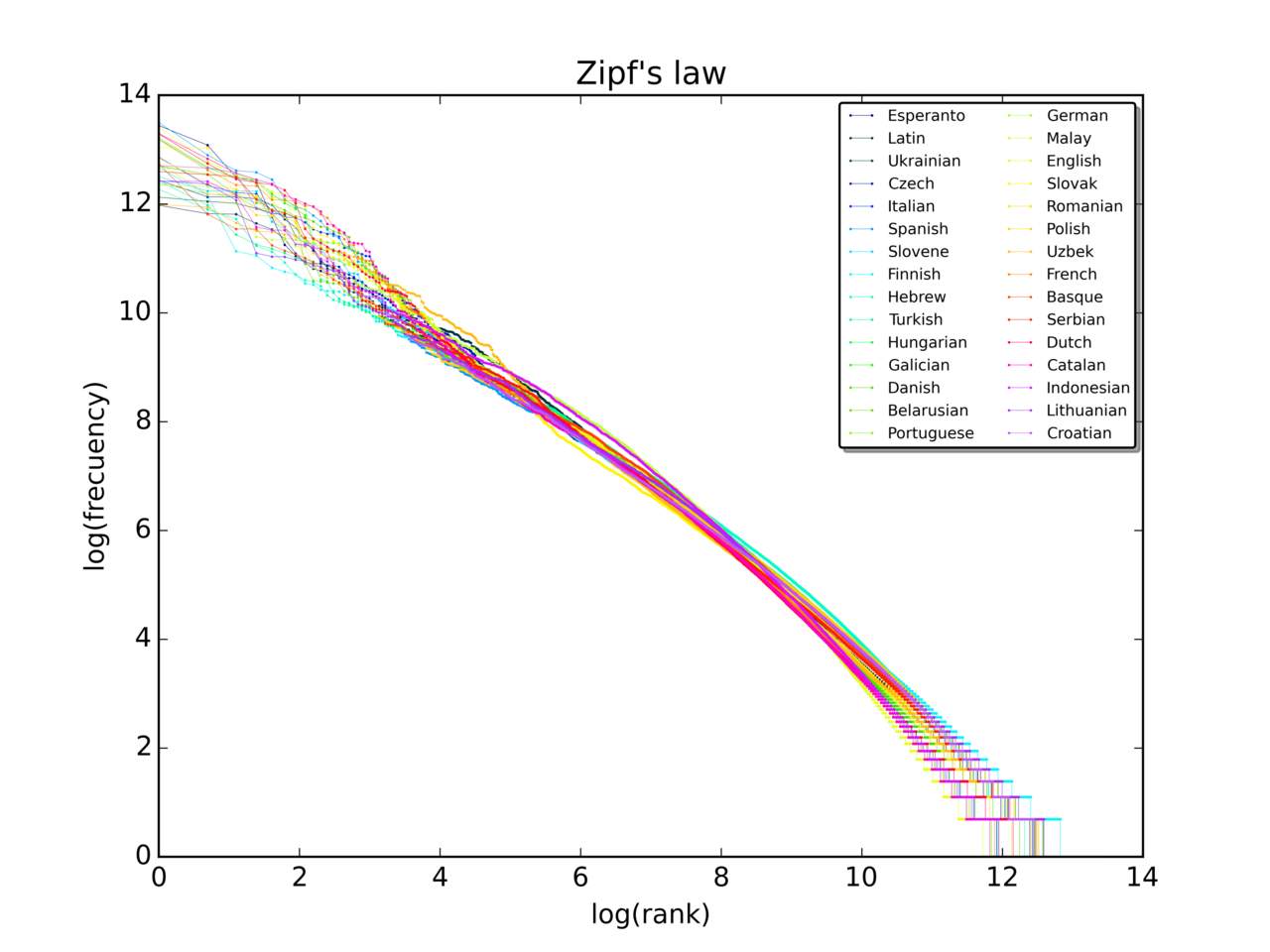
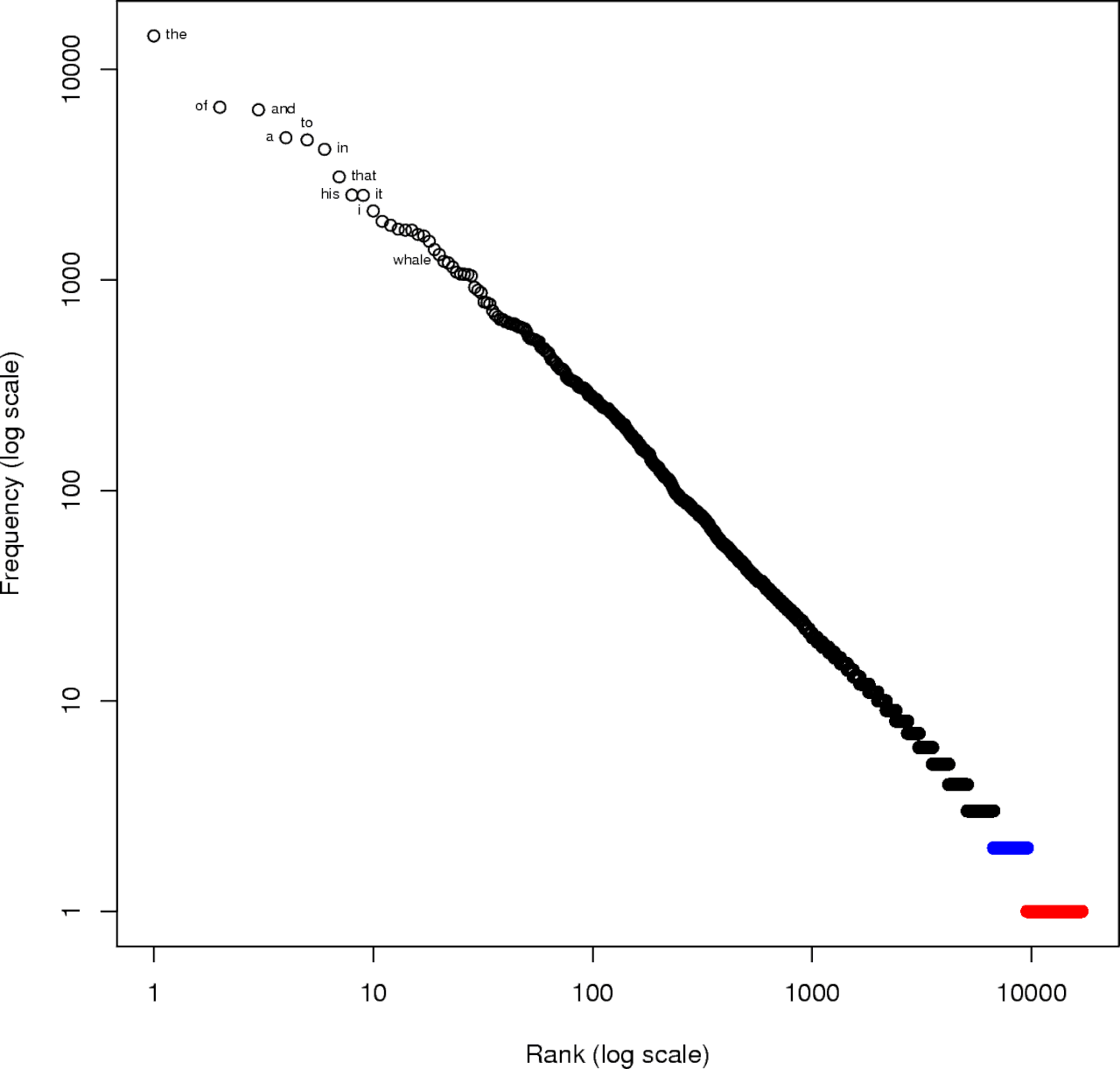
The tail of Zipf's distribution is brutal, though. Because word frequency falls off steeply after the first few hundred words, low-frequency vocabulary appears rarely in real text — in fact, researchers who study large collections of real-world text (corpora) estimate that somewhere between 40% and 60% of all unique words in a large corpus appear exactly once (a phenomenon known as hapax legomena — Greek for "said only once"). All those hours studying advanced vocabulary, and you might encounter two of your new words in an entire novel.

As a B1 learner:
- You spend hours studying 500 new B1+/B2 vocabulary words.
- Because those words are low-frequency, you might only encounter 1 or 2 of them in an entire chapter of a book or an episode of a show.
- You feel like your studying has zero tangible effect on your real-world comprehension — leading directly to the feeling of being stuck on a plateau.
Receptive vs. productive knowledge: why the gap widens
In SLA research, vocabulary knowledge is split into receptive (understanding when you hear or read a word) and productive (being able to use it spontaneously). The gap between the two is normal — it exists in your native language too. But something specific happens at B1: the gap stops narrowing and starts widening.
Laufer (1998) found that while receptive vocabulary size was larger than productive vocabulary in both beginner and intermediate learners, the gap between the two actually increased in more advanced groups. You're adding words to your receptive bank faster than your productive system can absorb them. The result feels like stagnation, even though you're still learning.
At A1–A2, the two types of knowledge grow in relative tandem — you learn 20 basic words (eat, water, house, want) and immediately use them in simple sentences. Understanding a word requires only recognition memory. When you hear a native speaker say "inevitable", your brain uses context to quickly decode the meaning. Producing the same word is a much heavier operation.
To overcome the plateau, learners must stop treating passive consumption (podcasts, reading) as output practice.

So what to do instead? The 4-step playbook to reach B2
Step 1: Ditch graded readers for "narrow" native content
Graded readers are great for A1–A2 learners, but they become a crutch at B1. They are designed to be easy and predictable, which means they don't expose you to the real-world complexity of the language.
Instead, seek out "narrow" native content: materials that are authentic, but focused on a specific topic or domain. This could be a podcast series on a subject you love, a YouTube channel that covers a hobby, or a blog that dives deep into a niche interest. The key is that the content should be engaging enough to keep you motivated, but not so broad that it overwhelms you with unfamiliar vocabulary.
Step 2: Turn passive input into active retrieval (output drills)
Write or speak about what you consume. After reading an article or listening to a podcast, summarize it in your own words. Use the new vocabulary and structures you've encountered. This forces your brain to retrieve and use the language actively, reinforcing your learning.
Lingoberry tries to do this by providing a platform where learners can practice output based on the input they consume, with immediate feedback. You can pick a topic, get a prompt, and then write or speak your response. The system will highlight errors and suggest corrections, helping you to refine your output and solidify your active vocabulary.
Step 3: Learn word clusters/chunks, not isolated vocab
Instead of memorizing individual words, focus on learning phrases and collocations. Language is often more about patterns and combinations than single words. For example, instead of just learning the word "make", learn phrases like "make a decision", "make an effort", or "make a mistake". This approach helps you to use the language more naturally and fluently, as you'll have ready-made chunks of language to draw from when speaking or writing.
Step 4: Seek targeted feedback (fix calcified errors)
Calcified errors are mistakes you've made so many times they've become automatic. Your brain has learned them as fluent output — wrong, but fluent. The longer they go uncorrected, the harder they are to dislodge. At B1, you've been producing language long enough for these to set in: a persistently wrong gender, a preposition you always misplace, a tense you default to even when it's incorrect.
Don't shy away from corrections. Seek out teachers, language exchange partners, or online platforms that provide constructive feedback on your output. The goal is to identify and correct persistent errors that have become ingrained in your language use. The sooner you address these, the easier it will be to break through the plateau and reach B2.
Conclusion
Reaching B2 is where a language truly becomes enjoyable. You'll be able to engage in more complex conversations, understand nuanced content, and express yourself more freely. The key is to shift your focus from passive learning to active production, embrace the challenge of using the language in real contexts, and seek feedback to refine your skills.
Pip's been waiting. Pick a topic, write something, see what comes out. You don't need to be ready — that's the whole point.
Until next time! 🌿
Sources
-
Nation, I.S.P. (2006). How large a vocabulary is needed for reading and listening? Cited and replicated in: Schmitt, N., Jiang, X. & Grabe, W. (2017). How much vocabulary is needed to use English? Language Teaching, 44(1), 59–80. https://www.cambridge.org/core/journals/language-teaching/article/how-much-vocabulary-is-needed-to-use-english-replication-of-van-zeeland-schmitt-2012-nation-2006-and-cobb-2007/1D217A56A2E0056E67802A6A8360FDDE
-
Laufer, B. (1998). The development of passive and active vocabulary in a second language: Same or different? Applied Linguistics, 19(2), 255–271. https://academic.oup.com/applij/article-abstract/19/2/255/316323
-
Evert, S. & Baroni, M. (2005). Testing the extrapolation quality of word frequency models. In Proceedings of the Corpus Linguistics 2005 conference. https://aclweb.org/anthology/J10-4003.pdf
-
Piantadosi, S.T. (2014). Zipf's word frequency law in natural language: A critical review and future directions. Psychonomic Bulletin & Review, 21(5), 1112–1130. https://pmc.ncbi.nlm.nih.gov/articles/PMC4176592/
-
Conti, G. (2025). Zipf's Law and What It Means for Vocabulary Teaching in Instructed Second Language Acquisition. https://gianfrancoconti.com/2025/04/14/zipfs-law-and-what-it-means-for-vocabulary-teaching-in-isla/
Related posts
Want to practise what you've read?
Lingoberry gives you AI-powered translation, dictation, and speaking exercises — guided by Pip.
Try Lingoberry — it's freeComments
Join the conversation!
Log in to commentNo comments yet. Be the first to share!