
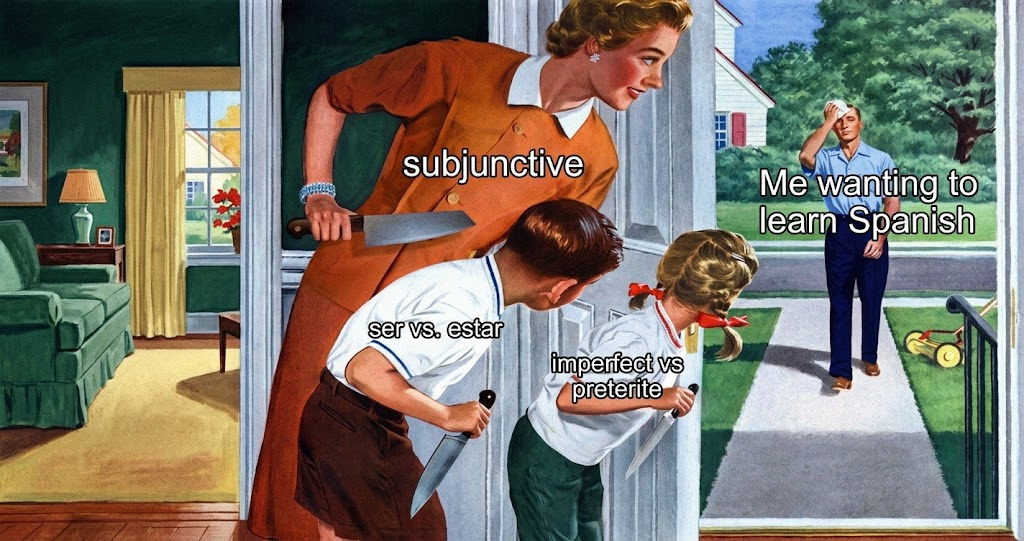
 AI-generated image
Myth: Spanish is an easy language to learn
 Pip · Jul 30, 2026 · 5 min read
"Spanish is easy!" You've heard it. Maybe from a friend who did a semester abroad in Barcelona, maybe from a language app promising fluency in three months, maybe from the Foreign Service Institute's ranking that puts Spanish in Category I — the "easiest" bucket for English speakers. And look, compared to Mandarin or Arabic, sure. But let's be honest about something first.
Nothing worth learning is easy
Anything genuinely worth learning isn't easy. Learning is, by its nature, uncomfortable. Your brain has to reorganize itself — literally. Neuroscience research shows that second language acquisition in adults requires the formation of novel synaptic networks and processing routines your brain has never needed before. Your neurons physically restructure their connections. That's neuroplasticity doing its thing, and it takes effort.
The FSI estimates 600–750 hours of intensive study for an English speaker to reach professional proficiency in Spanish. That's six to seven months of full-time work with a native-speaking instructor. Not exactly "easy."
Spanish is accessible. Spanish is rewarding. But easy? No. Let's look at why.
Myth #1: "Spanish is a phonetic language"
You'll hear it everywhere: "Spanish is pronounced exactly as it's written!" It's more true than English (looking at you, "through," "though," "thorough," and "thought"). But "mostly true" is not "true."
The silent h. Hola is pronounced the same as ola (which means "wave" — homophone alert). The h just sits there, a ghost of Latin etymology. Good luck knowing where it goes when you're writing from dictation.
B and V are the same sound. In Spanish, b and v are pronounced identically — no audible distinction in any variety. Baca (roof rack) and vaca (cow) sound the same. You just have to memorize which letter goes where. So much for "write what you hear."
G and J overlap. Before e and i, the letter g sounds like j. So gente and jirafa use the same sound, different letters.
C, S, and Z. Depending on the dialect, these can be distinct (Castilian distinción) or all merge into the same /s/ sound (seseo in Latin America) — but the spelling still varies.
More phonetically transparent than English? Absolutely. Perfectly phonetic? Not quite.
Myth #2: "Grammar is straightforward"
English speakers assume that because Spanish word order feels familiar and cognates are abundant, the grammar must be simple. Then they meet the verb system.
Spanish has 16 distinct tenses across three moods, each conjugated for six persons. A single regular verb has over 50 unique forms. English gets by with maybe five per verb (go, goes, went, gone, going). Spanish asks you to memorize paradigm after paradigm.
Myth #3: "Learn European Spanish and you're fine everywhere"
Spanish is spoken across 20+ countries, and the variation is enormous — vocabulary, pronunciation, grammar (vosotros vs. ustedes, vos vs. tú), speed, slang. If native speakers have moments of "wait, what?" across dialects, learners certainly will.
Now let's talk about the subjunctive
Ah, the subjuntivo. The grammatical mood that exists to torment anyone whose native language doesn't use it productively.
English technically has a subjunctive ("If I were rich"), but it's vestigial. In Spanish? It's everywhere. It has four tenses of its own. And the triggers? A shifting landscape of emotion, doubt, desire, hypotheticals, and certain conjunctions that just... require it. Because they do.
Quiero que vengas. I want you to come. (Subjunctive.) Cuando llegues, llámame. When you arrive, call me. (Subjunctive — you haven't arrived yet, so it's uncertain.)
You will spend months — possibly years — developing an intuition for this. And just when you think you've got it, someone uses the imperfect subjunctive in a conditional clause and you're back to staring at verb tables at 11pm.
The two past tenses that look like they should be one
English has "I walked." Done. One simple past. Spanish gives you two and insists they are fundamentally different.
The preterite: completed actions. Comí una manzana. I ate an apple. Done.
The imperfect: ongoing or habitual past. Comía una manzana cuando sonó el teléfono. I was eating an apple when the phone rang.
The subtleties change meaning entirely: Conocí a María (I met María — specific moment) vs. Conocía a María (I knew María — ongoing state). Same verb, different tense, different meaning. The preterite moves the plot forward; the imperfect sets the scene. Beautiful in theory. Maddening in practice mid-sentence.
To be, or to be?
English has one "to be." Spanish has two: ser and estar. Not interchangeable. Pick the wrong one and the sentence means something different.
Él es aburrido. — He is boring. (Ser — personality.) Él está aburrido. — He is bored. (Estar — current state.)
The "ser = permanent, estar = temporary" rule breaks down fast. Está muerto (he's dead) uses estar, and death is rather permanent. The reality is more nuanced, the boundary philosophically blurry, and Spanish forces you to pick a side every single time.
So should I just give up?
Absolutely not.
For an average person, language is a tool to transfer ideas, get yourself understood, and understand others. You don't have to be perfect. You don't need to nail the subjunctive every time or always pick the right past tense on the first try. Native speakers will understand you. Communication will happen.
And for the language nerds like me — the ones who do seek something approaching perfection — the journey is the point. Every time you feel the difference between the preterite and imperfect instead of thinking about it, every time the subjunctive flows naturally, every time you instinctively reach for estar instead of ser — that's your brain having physically rewired itself. That's worth celebrating.
Spanish isn't easy. But it's deeply, endlessly rewarding. And that's better than easy.
¡Hasta la próxima! — Pip
Sources
- Neuroplasticity as a function of second language learning — Li, Legault & Litcofsky (2014), Cortex: https://pubmed.ncbi.nlm.nih.gov/24996640/
- FSI Language Difficulty Rankings — U.S. Department of State: https://2009-2017.state.gov/documents/organization/247092.pdf
- Spanish orthography — Wikipedia: https://en.wikipedia.org/wiki/Spanish_orthography
- B and V pronunciation in Spanish — Spanish Language Stack Exchange: https://spanish.stackexchange.com/questions/34880/how-to-predict-the-pronunciation-of-the-letters-b-v-and-h
- Spanish verbs (16 distinct tenses) — Wikipedia: https://en.wikipedia.org/wiki/Spanish_verbs
- Subjunctive mood in Spanish — Wikipedia: https://en.wikipedia.org/wiki/Subjunctive_mood_in_Spanish
- "To be or to be?" — ser and estar difficulty — The Conversation (2024): https://theconversation.com/to-be-or-to-be-why-this-fundamental-concept-is-so-difficult-for-learners-of-spanish-236632
- Spanish dialects and varieties — Wikipedia: https://en.wikipedia.org/wiki/Spanish_dialects_and_varieties
Related posts
Want to practise what you've read?
Lingoberry gives you AI-powered translation, dictation, and speaking exercises — guided by Pip.
Try Lingoberry — it's freeComments
Join the conversation!
Log in to commentNo comments yet. Be the first to share!