
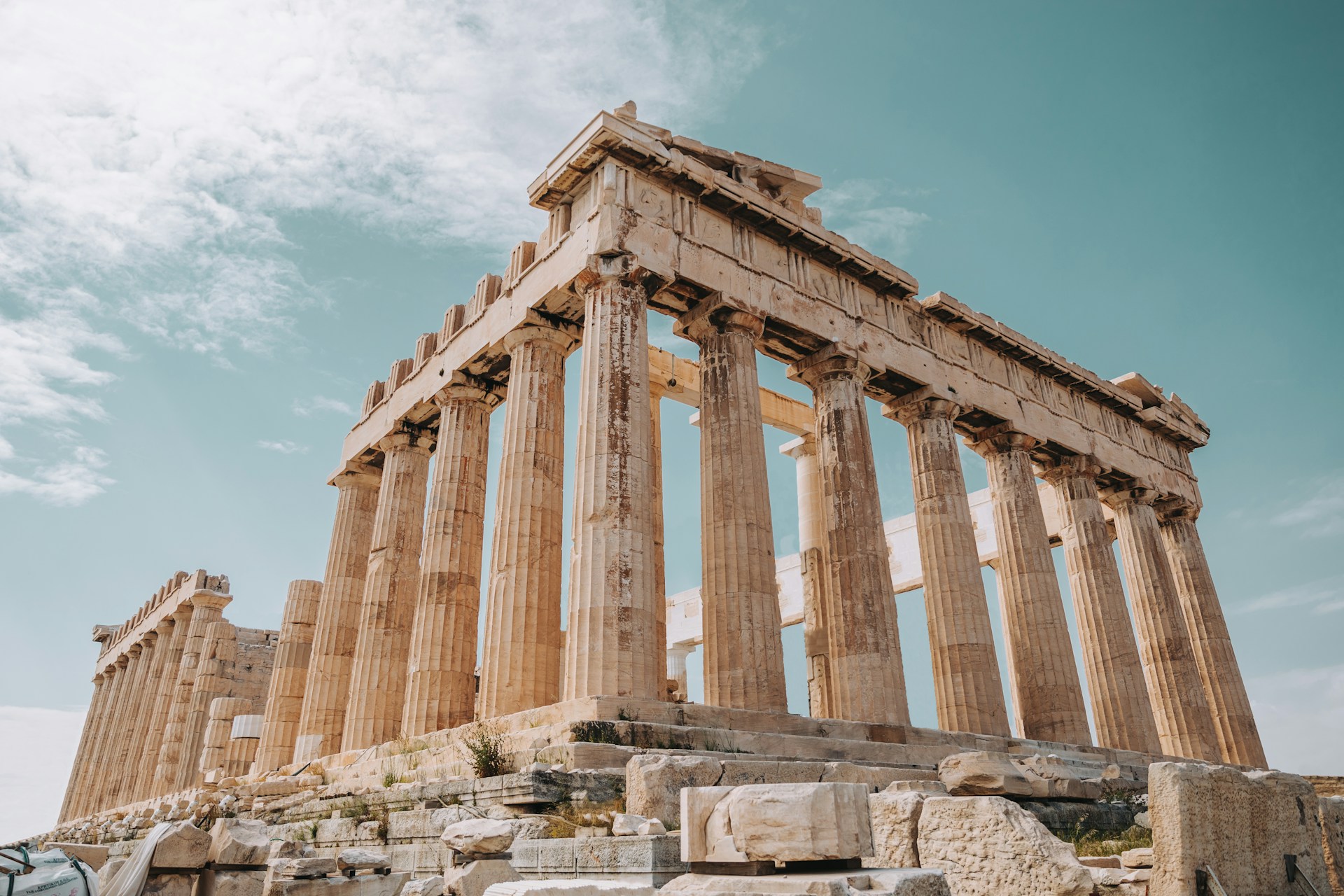
Parthenon temple in Athens Greece - Photo by Spencer Davis on Unsplash
Mythology & Language, Part 1: How Greek Gods Shaped Modern Vocabulary

Pip
Sep 19, 2026 · 6 min read
This is Part 1 of a three-part series exploring how ancient mythologies shaped the vocabularies of modern European languages. We'll journey from Mount Olympus (Greek) to the Roman Forum to the halls of Valhalla (Norse), discovering how gods and heroes became the words we use every day.
Ever wondered why we call an impossible task "Herculean" or describe someone's weakness as their "Achilles heel"? The ancient Greeks didn't just give us democracy and philosophy — they gifted us thousands of words that we still use every day, often without realizing their mythological origins.
Let's explore how the gods, heroes, and monsters of Mount Olympus live on in modern languages.
The Olympians in Your Vocabulary
The Greek gods weren't just characters in stories — they became the building blocks of scientific, artistic, and everyday vocabulary across European languages.
Aphrodite, the goddess of love, gave us aphrodisiac (something that arouses desire). Her Roman counterpart Venus lives on in venereal and the element copper (from Latin cuprum, named for Cyprus, her sacred island).
Athena, goddess of wisdom, lends her name to the Greek capital Athens. Her Roman equivalent Minerva shares roots with mind (both from Proto-Indo-European *men-, "to think") and gave us the idiom invita Minerva — doing something against one's natural talent.
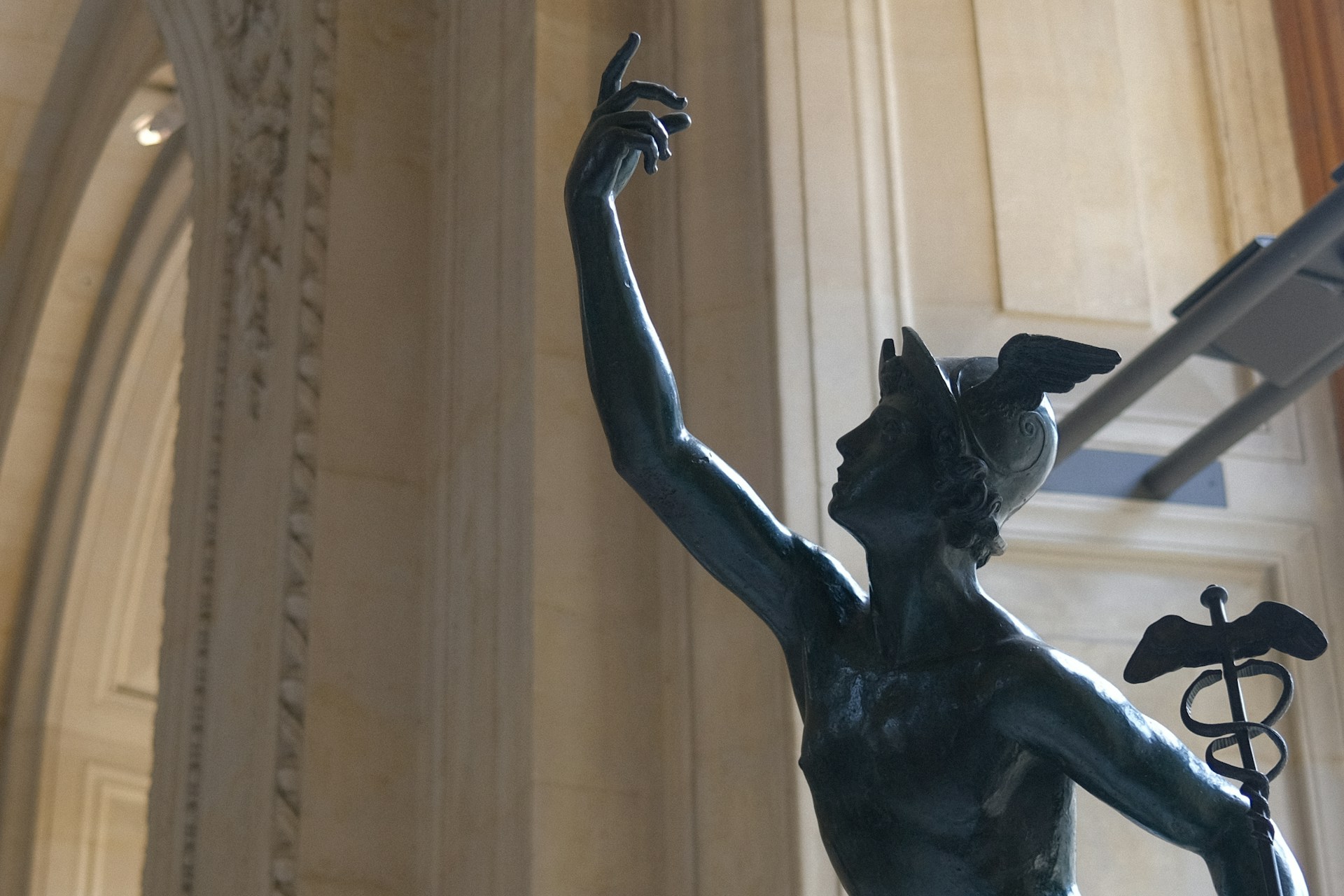
Hermes, the messenger god with winged sandals, gave us hermetic (airtight, sealed — from Hermes Trismegistus, the legendary fusion of Hermes and the Egyptian god Thoth, who was central to alchemy) and hermeneutics (the art of interpretation). His staff, the caduceus, is the symbol of commerce and diplomacy — though it's often confused with the Rod of Asclepius, the true symbol of medicine.
Hypnos, the god of sleep, is why we call the practice hypnosis. His son Morpheus, god of dreams, gave us morphine — the drug that brings dreamlike states.
Heroes Turned Adjectives
Greek heroes didn't just slay monsters — they became adjectives we reach for when ordinary words won't do.
| Hero | Modern Word | Meaning |
|---|---|---|
| Heracles (Roman: Hercules) | Herculean | Requiring enormous strength or effort (Herculean entered English via the Latin form Hercules) |
| Achilles | Achilles heel | A fatal weakness despite overall strength |
| Narcissus | Narcissistic | Excessive self-love |
| Mentor | Mentor | A wise guide (Mentor was Odysseus's trusted advisor) |
| Stentor | Stentorian | Extremely loud (Homer described him as having a voice like 50 men) |
The word panic comes from Pan, the wild god of shepherds, whose sudden appearances in lonely places terrified travelers. That irrational, overwhelming fear? Pure Pan.

Monsters in Modern Speech
Even the terrifying creatures of Greek myth left their mark:
Chimera — a fire-breathing monster with a lion's head, goat's body, and serpent's tail — now means any impossible fantasy or hybrid creation. In genetics, a chimera is an organism with cells from different sources.
Siren — the creatures who lured sailors to their deaths with irresistible songs — gave us the warning siren and the adjective siren (dangerously alluring).
Hydra — cut off one head, two grow back. Today, a hydra describes any problem that multiplies when you try to solve it.
Typhon — the father of monsters who created devastating storms — shares a curious coincidence with typhoon. The word actually comes from Arabic ṭūfān (storm) and Cantonese daai-fung (大風, "great wind"), but early European writers, familiar with the Greek monster, respelled it typhoon — a striking coincidence across millennia rather than intentional borrowing.
The Muses: Nine Goddesses, Nine Words
The nine Muses, daughters of Zeus who inspired artists and thinkers, gave us:
- Music — from Mousike, "the art of the Muses"
- Museum — originally a temple to the Muses
- Muse — as a verb, to think deeply; as a noun, a source of inspiration
- Amuse — from Old French "to cause to muse, divert the attention"; originally meaning to beguile or distract
Each Muse ruled a specific art: Clio (history), Thalia (comedy), Melpomene (tragedy), Terpsichore (dance), Erato (love poetry), Polyhymnia (hymns), Urania (astronomy), Calliope (epic poetry), and Euterpe (lyric poetry). Terpsichorean still means "relating to dance" in formal English.
Quick Reference: Greek Myth → Modern Word
| Mythological Origin | Modern Word(s) |
|---|---|
| Eros (god of love) | Erotic, erogenous |
| Thanatos (death personified; thanatos = death, as in eu-thanasia) | Euthanasia |
| Chronos (time personified) | Chronological, chronic |
| Gaia (Earth goddess; gē/gaīa = earth) | Geography, geology, geometry |
| Helios (sun god) | Helium, heliocentric |
| Selene (moon goddess) | Selenium |
| Atlas (Titan who held the sky) | Atlas (book of maps) |
| Echo (nymph cursed to repeat) | Echo |
| Psyche (goddess of the soul) | Psychology, psyche |
| Nemesis (goddess of revenge) | Nemesis |
Test Your Knowledge
The word "narcissistic" comes from a Greek myth about someone who:
Beyond English
These Greek roots didn't just enter English — they spread across all European languages through Latin and later scientific naming conventions:
| Concept | English | Spanish | French | German |
|---|---|---|---|---|
| Study of the mind | Psychology | Psicología | Psychologie | Psychologie |
| Fear of heights | Acrophobia | Acrofobia | Acrophobie | Akrophobie |
| Self-obsession | Narcissism | Narcisismo | Narcissisme | Narzissmus |
| Enormous task | Herculean | Hercúleo | Herculéen | Herkulisch |
The Greek roots are recognizable across languages — once you know them, you can decode scientific and medical terminology in almost any European language.
The Takeaway
Greek mythology isn't just ancient stories — it's living vocabulary. Every time you describe a task as Herculean, call someone's flaw their Achilles heel, or visit a museum, you're speaking Greek mythology.
Next time, we'll explore how the Romans adapted these same myths and added their own linguistic legacy — from the calendar to the planets to the very word "volcano."
Sources
- Etymonline — etymonline.com — entries for aphrodisiac, hermetic, morphine, panic, chimera, typhoon, amuse
- Wikipedia — Greek Mythology
- Homer. Iliad, Book V (Stentor reference) — free on Project Gutenberg
- Oxford English Dictionary — oed.com — entries for copper, museum (subscription required; many libraries offer free access)
Until next time! — Pip 🌿
Related posts
Want to practise what you've read?
Lingoberry gives you AI-powered translation, dictation, and speaking exercises — guided by Pip.
Try Lingoberry — it's freeComments
Join the conversation!
Log in to commentNo comments yet. Be the first to share!