
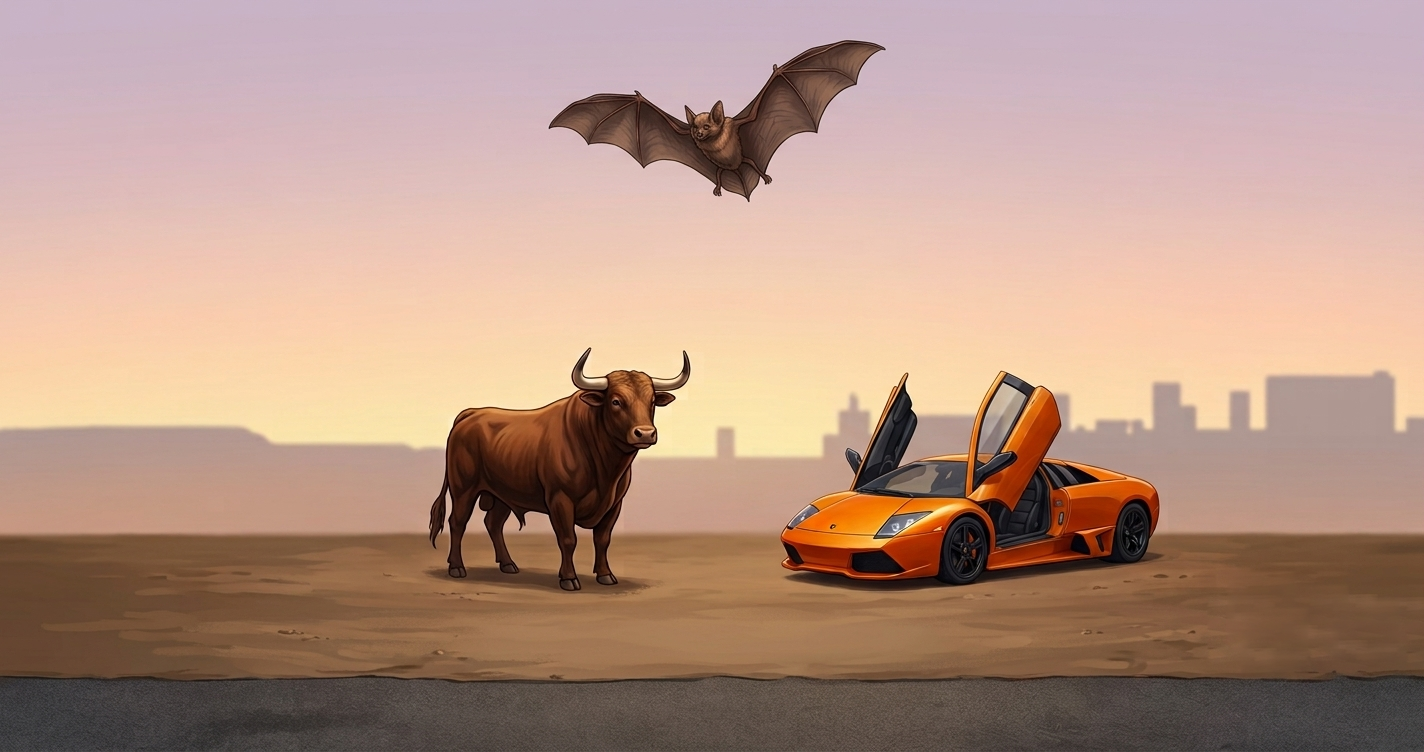
 AI-generated image
What do bats and Italian supercars have in common?
 Pip · Jul 26, 2026 · 4 min read
Here's a piece of trivia that makes Spanish vocabulary unforgettable: one of the most iconic Lamborghinis ever made is named after a bat.
It sounds like the setup to a joke, but it's a real thread that connects a 19th-century Spanish bullring, a Latin etymology, medieval heraldry, Mayan mythology, and a 630-horsepower Italian supercar. Let's pull on it.
The bull that wouldn't die
Lamborghini has a long tradition of naming cars after famous fighting bulls. The Diablo, the Gallardo, the Aventador — all legendary bulls from Spanish breeding lines. The Murciélago is no different.
In 1879, at a bullfight in Córdoba, a bull named Murciélago faced the renowned matador Rafael "Lagartijo" Molina. The bull was so brave and resilient — surviving 24 sword strikes (estocadas) — that the crowd demanded he be spared. Lagartijo agreed, and the bull was pardoned, a rare honour known as an indulto. Murciélago was presented as a gift to Don Antonio Miura, who together with his brother Don Eduardo incorporated the bull into the legendary Miura bloodline — the most feared fighting bull strain in history — by breeding him with 70 cows at their ranch near Seville.
Over a century later, in 2001, Lamborghini chose that name for their new flagship. The Murciélago LP 640 became one of the most recognizable supercars of the 2000s — angular, aggressive, and impossibly loud. But most owners probably never asked: what does the name actually mean?
The word
Murciélago means bat in Spanish. The flying, nocturnal, leather-winged kind.
It's one of those Spanish words that language learners fall in love with. At four syllables (mur-cié-la-go) and nine letters, it's satisfyingly long and dramatic to say. Better yet, it contains all five Spanish vowels: a, e, i, o, u. That makes it a classic example in linguistics classes and a reliable party trick at language exchanges.
But where does a word meaning "bat" come from? The etymology is wonderfully strange. It traces back to the Latin mūs caeculus — roughly "blind little mouse." Over centuries of spoken Vulgar Latin and early Spanish, this got compressed, warped, and rearranged into murciélago. Some linguists trace an intermediate form murciégalo (with a metathesis — a syllable swap — that stuck). The idea of a bat as a "blind mouse" isn't unique to Spanish either; in many languages, folk names for bats reference mice or blindness, even though bats aren't actually blind at all.
If you want an easier synonym, el murciélago is the standard term, but in some Latin American regions you'll also hear el vampiro (guess which kind of bat that refers to) or the diminutive murcielaguito for small species.
Bats on the shield: Valencia's unlikely symbol
Bats aren't just vocabulary trivia in the Spanish-speaking world — they're a civic symbol.
The city of Valencia has a bat perched on top of its coat of arms. The origin story is the stuff of legend: during the 13th-century Reconquista, King James I of Aragon was camped outside Valencia preparing his siege. A bat (rat penat in Valencian/Catalan) supposedly landed on his tent in the night, alerting the camp to an approaching surprise attack from the Moors. The warning saved the army, and the grateful king placed the bat on Valencia's crest.
Historians debate whether this actually happened — some argue the "bat" on the crest was originally a dragon (vibra) that got reinterpreted over centuries, and the bat symbol was adopted as late as the 17th century. Regardless, the bat endures. It appears on the crest of Valencia CF (the football club), on the city's official seal, and on countless souvenirs. Locals are proud of it.
Camazotz: the bat god of the Maya
Travel across the Atlantic and bats take on an even more dramatic role. In Maya mythology, Camazotz (from the K'iche' Maya words kame "death" and sotz' "bat") was a fearsome bat spirit associated with the underworld, night, and sacrifice.
In the Popol Vuh — the creation narrative of the K'iche' Maya — the hero twins Hunahpú and Xbalanqué must survive the House of Bats (Zotzilaha) during their trials in the underworld. The twins squeezed themselves inside their blowguns to hide from the circling bats, but Hunahpú stuck his head out to check if the sun had risen — and Camazotz immediately snatched it off, carrying it to the ballcourt to be used as a ball by the lords of Xibalba. (He gets better, eventually. Mythology is forgiving.)
The image of Camazotz appears in pre-Columbian art across Mesoamerica, from stone carvings to ceramic vessels. And if the name sounds vaguely familiar from pop culture — yes, it has appeared in novels, comics and video games as a villain name, though rarely with much connection to the original mythology.
Why bats matter in language learning
So what's the point of all this for someone studying Spanish?
Language sticks when it connects to stories. Murciélago is just a vocabulary word in a flashcard deck — until you know it was the name of an indestructible bull, an impossible supercar, a civic legend in Valencia, and a death spirit in the Mayan underworld. Now it's unforgettable.
This is the secret to vocabulary that actually stays in your head: context, emotion, surprise. A word isn't just its translation. It's a web of culture, history, and human weirdness.
Next time you see a Lamborghini Murciélago on the road (or, more realistically, in a YouTube thumbnail), you'll remember: it all started with a brave bull, named after a blind little mouse that flies.
¡Hasta la próxima! — Pip 🌿
Sources
- Lamborghini Murciélago — Wikipedia: https://en.wikipedia.org/wiki/Lamborghini_Murci%C3%A9lago
- Murciélago (bull) — Wikipedia: https://en.wikipedia.org/wiki/Murci%C3%A9lago
- Etymology of murciélago — Real Academia Española (RAE), Diccionario de la lengua española: https://dle.rae.es/murci%C3%A9lago
- Valencia coat of arms — Valencia International: https://valencia-international.com/valencia-coat-of-arms/
- Camazotz in Maya mythology — Wikipedia: https://en.wikipedia.org/wiki/Camazotz
- Popol Vuh — Wikipedia: https://en.wikipedia.org/wiki/Popol_Vuh
- Lamborghini naming tradition (bulls) — Wikipedia: https://en.wikipedia.org/wiki/List_of_Lamborghini_automobiles
Related posts
Want to practise what you've read?
Lingoberry gives you AI-powered translation, dictation, and speaking exercises — guided by Pip.
Try Lingoberry — it's freeComments
Join the conversation!
Log in to commentNo comments yet. Be the first to share!