
Asking for directions in Finnish
Last updated 27 October 2026
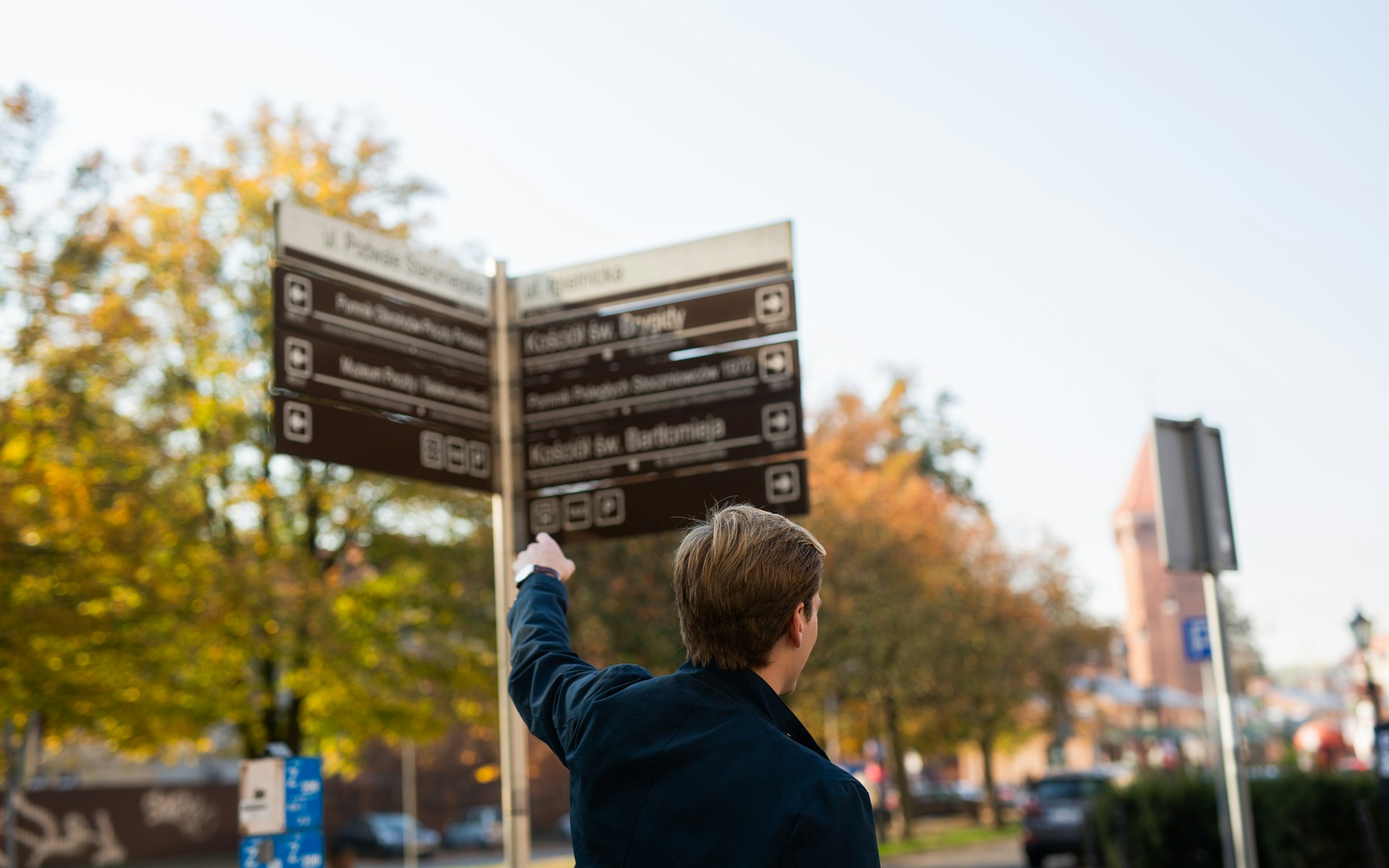
Asking the way is a good first test of Finnish in a real situation. Most people will answer with short, simple directions, so a few key phrases go a long way. This page covers how to ask, the directions you are likely to hear, and how to describe where something is.
Asking the way
- Anteeksi, missä on rautatieasema? Excuse me, where is the train station?
- Kuinka pääsen keskustaan? How do I get to the city centre?
- Missä on lähin kahvila? Where is the nearest café?
- Voitteko näyttää kartalta? Could you show me on the map?
Anteeksi is the word to start with, because it gets the attention of a stranger. Kuinka pääsen literally means "how can I get", and it is the natural way to ask how to reach a place. Voitteko is the polite form of "can you", so use it when you ask a stranger for help.
Directions you will hear
People giving directions usually speak in the imperative. These examples use sinä, the singular form, which is what most people use with strangers.
- Mene suoraan. Go straight ahead.
- Käänny vasemmalle. Turn left.
- Käänny oikealle. Turn right.
- Mene ensimmäisestä risteyksestä oikealle. Turn right at the first intersection.
- Ylitä silta. Cross the bridge.
- Kävele kolme minuuttia. Walk for three minutes.
Risteys means "intersection", and ensimmäinen means "first". Together they form a common pattern: "at the first intersection", followed by the direction. Listen for vasemmalle (left) and oikealle (right); they are the two words you will hear most.
Describing where something is
- Se on tuolla. It is over there.
- Se on lähellä. It is nearby.
- Se on kaukana. It is far away.
- Se on kadun toisella puolella. It is on the other side of the street.
- Se on kadun oikealla puolella. It is on the right-hand side of the street.
Tuolla means "over there", and it works well when you point. Kadun toisella puolella uses two parts: kadun (of the street) and toisella puolella (on the other side). Learn the whole phrase as one unit.
Tips
- Finnish directions often use the cardinal directions less than English does. People are more likely to say "turn left at the church" than "head north".
- If you do not understand, you can say Puhun vähän suomea (I speak a little Finnish) and ask the person to slow down or repeat. Voisitteko toistaa? means "could you repeat that?".
- Say kiitos (thank you) at the end. Ole hyvä is the common reply, and it means "you're welcome".
Practice
Choose the phrase that fits each moment.
You want to ask where the train station is. What do you say?
Once you have found your way, you can order a meal.
More in Phrases and vocabulary
Read the rule, then use it. Write your own sentences and get Pip's feedback on them.
Start Learning Free