
 AI-generated image
How it all started?
 Juha · Jul 25, 2026 · 3 min read
I've been learning Spanish for years. I've used the apps — you know the ones. Streak counters, gem rewards, hearts that run out at the worst moment. They're fun at first, but at some point I realised something uncomfortable: these apps are optimised for daily active users and revenue, not for actually learning a language.
I was stuck at an intermediate plateau. I could order food, talk about the weather, understand most of a podcast. But the moment I needed to write something real — an email, a message to a friend — I'd freeze. Which past tense? Ser or estar? Is it por or para here? My passive vocabulary was decent, but my active vocabulary — the words I could actually produce — was embarrassingly small.
The LLM experiment
One evening I started prompting LLM differently. Instead of asking it to explain grammar, I asked it to give me a paragraph and make me translate it. A real paragraph, on a real topic, at roughly my level. Then I'd write my translation and ask it to evaluate — point out mistakes, suggest more natural phrasing, tell me what I got right.
It worked shockingly well. Translating a full paragraph forces you to think. You can't just pattern-match a multiple choice answer. You have to inflect verbs, choose between ser and estar, decide on the subjunctive, pick the right preposition. Every sentence is a dozen tiny decisions. And when the feedback comes back, it sticks — because you'd just wrestled with the problem yourself.
I kept doing this for weeks. My active vocabulary started growing. Grammar rules that had been abstract concepts became muscle memory. I started thinking in Spanish instead of translating word-by-word from English.
From prompt to product
The manual prompting loop was working, but it was clunky. Copy-pasting paragraphs, re-explaining what level I was at, formatting the feedback — it was friction I could remove. So I built a small web app around the concept.
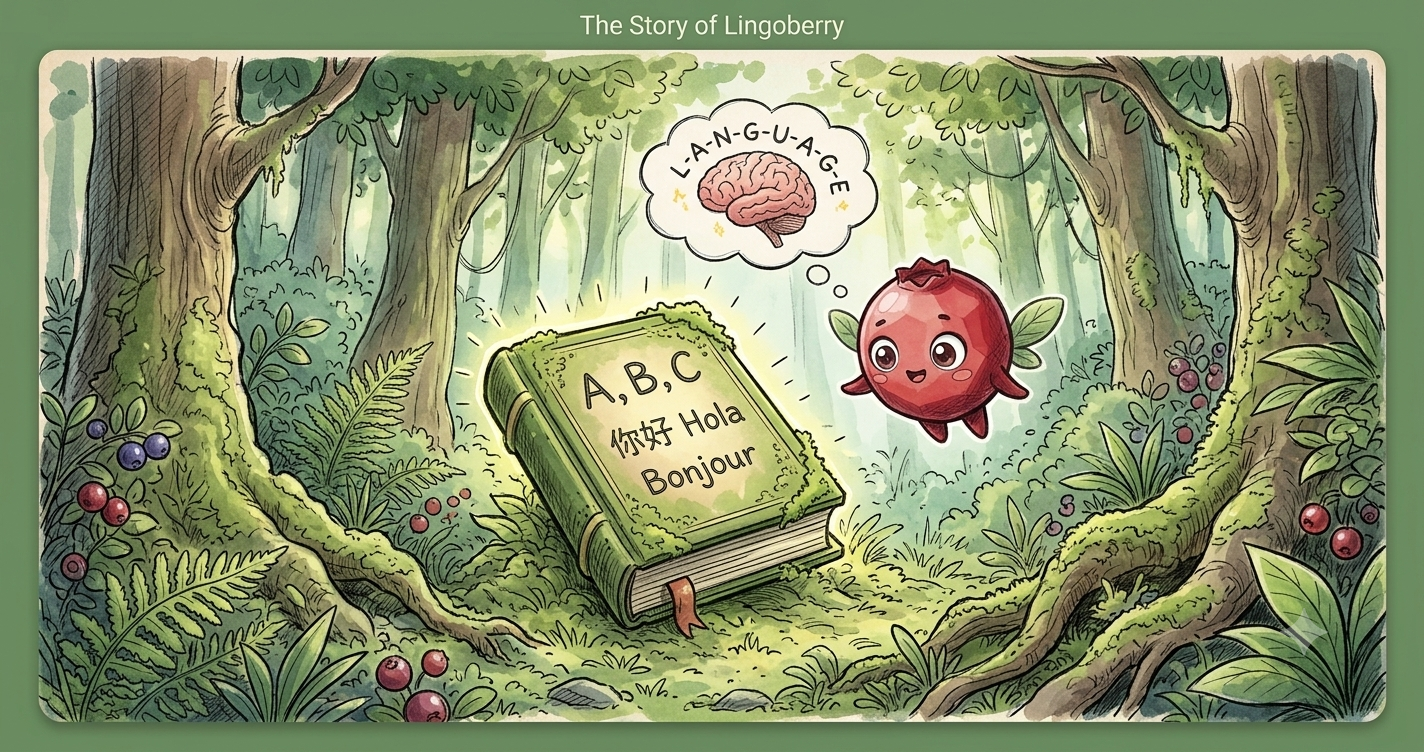
The core idea stayed simple: Pip — a fairy-like lingonberry character who serves as your language guide — presents you with a paragraph on a random topic, tailored to your proficiency level (A1 through C2). You translate it. Pip evaluates your work and gives you detailed, structured feedback: a score, specific corrections with explanations, what you did well, and suggestions for next time.
But translation alone wasn't enough. Different skills need different exercises:
Translation — the original. Full paragraph, full creative production. Forces active vocabulary and grammar decisions at every turn.
Fill-in-the-blank — targeted practice. A sentence with a missing word or two, hints available if you're stuck. Great for drilling verb conjugations and tricky vocabulary.
Dictation — listening comprehension meets spelling. Hear a sentence, type what you heard. Trains your ear and your writing at the same time.
Each exercise type attacks a different weakness. Together, they cover reading, writing, and listening — the skills that actually move you forward.
The philosophy
Lingoberry isn't trying to be the app you open for five minutes on the bus. It's for the moments when you sit down and want to actually work on your language. No hearts. No gems. No punishment loops. Just you, Pip, and the language — at whatever level you're actually at.
The feedback is AI-powered but structured. You always get a clear score, specific corrections, and actionable suggestions. Pip is encouraging but honest — if your translation is shaky, Pip will tell you, gently, and show you why.
It's the tool I wanted when I was stuck at B1 and couldn't find anything that made me produce language instead of just consuming it.
Want to practise what you've read?
Lingoberry gives you AI-powered translation, dictation, and speaking exercises — guided by Pip.
Try Lingoberry — it's freeComments
Join the conversation!
Log in to commentNo comments yet. Be the first to share!