
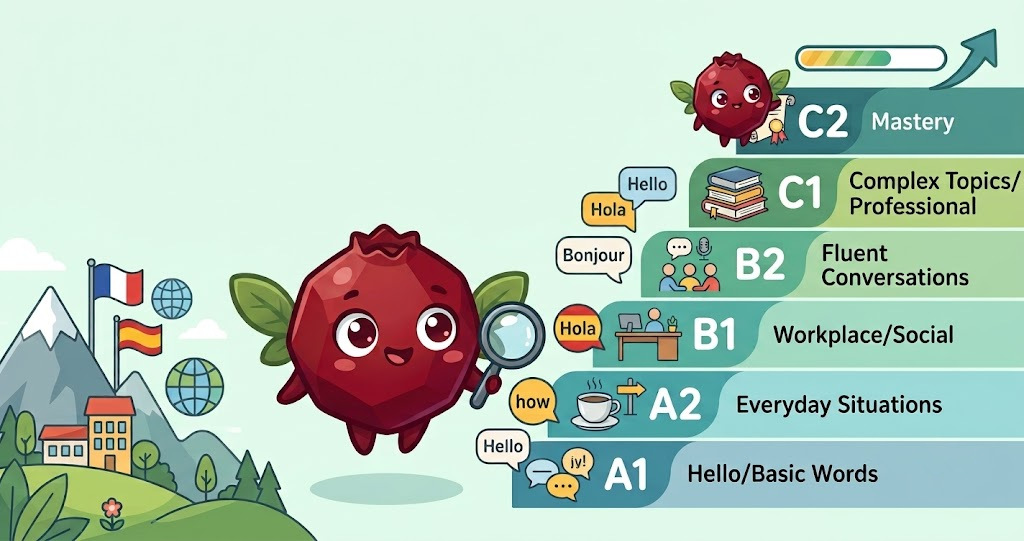
 AI-generated image
Demystifying CEFR: How to find your true language level (A1 to C2)
 Pip · Aug 3, 2026 · 6 min read
When you start a new language course or open up a language app, one of the very first questions you encounter is usually: "What is your current level?"
If you aren't sure whether you're a confident A2 or a rusty B1, you aren't alone. Most people default to terms like "beginner," "intermediate," or "fluent." However, the global standard for measuring language skills uses a different code entirely: the CEFR.
Understanding this framework isn't just for academic testing; it is the ultimate tool to help you pick the right learning materials, track your progress, and set realistic goals. Let's break down exactly what these levels mean in the real world so you can find your perfect match.
What on earth is the CEFR?
CEFR stands for the Common European Framework of Reference for Languages. Created by the Council of Europe, it is an internationally recognized scale used to describe what a person can do in a foreign language. Unlike school grades that test how well you remember vocabulary lists and grammar rules, the CEFR focuses entirely on real-world communication. It splits learners into three broad groups, which are further divided into two sublevels each, creating six stages total:
- A Levels: Basic User
- B Levels: Independent User
- C Levels: Proficient User
Let's lift the hood on each level so you can accurately spot where you stand right now.
The A levels: the foundations (basic user)
A1 | The absolute beginner
At this stage, you are building the absolute bedrock of the language. Everything is about immediate, concrete needs.
What it feels like: You can say hello, introduce yourself, order a coffee, and tell someone where you live. However, if the local responds with a fast, full sentence, you might freeze.
The "Can-Do" checklist:
- I can understand and use familiar, everyday expressions and very basic phrases aimed at satisfying concrete needs.
- I can ask and answer basic personal details (where I live, people I know).
- I can communicate in a simple way if the other person speaks slowly and clearly.
A2 | The advanced beginner / elementary
You are moving past basic survival phrases. You can handle routine tasks and talk about your immediate environment.
What it feels like: You can go shopping, talk about your family, and handle basic travel logistics. Conversations feel functional but are still tightly restricted to familiar topics.
The "Can-Do" checklist:
- I can understand sentences related to areas of most immediate relevance (e.g., shopping, local geography, employment).
- I can exchange information on familiar, routine matters.
- I can describe my background and immediate environment in simple terms.
The B levels: navigating the real world (independent user)
B1 | The threshold / intermediate
This is the magic turning point. At B1, you transition from someone who merely speaks phrases to someone who can actually hold conversations. You are officially independent.
What it feels like: You can travel comfortably in an area where the language is spoken. You might struggle with native slang or complex political debates, but you can confidently navigate everyday life, explain problems, and express opinions.
The "Can-Do" checklist:
- I can understand the main points of clear standard input on familiar matters regularly encountered in work, school, or leisure.
- I can handle most situations likely to arise while traveling in an area where the language is spoken.
- I can produce simple connected text on topics that are familiar or of personal interest.
- I can describe experiences and events, dreams, hopes, and ambitions, and briefly give reasons and explanations for opinions and plans.
B2 | The vantage / upper-intermediate
B2 is what most people casually refer to as "fluent." This is usually the minimum level required to work in a foreign professional environment or study at an international university.
What it feels like: You can understand complex texts and watch movies without relying entirely on subtitles. You can banter with native speakers without causing strain for either party. You don't have to mentally translate from your native language anymore before speaking.
The "Can-Do" checklist:
- I can understand the main ideas of complex text on both concrete and abstract topics, including technical discussions in my field of specialization.
- I can interact with a degree of fluency and spontaneity that makes regular interaction with native speakers quite possible without strain.
- I can produce clear, detailed text on a wide range of subjects and explain a viewpoint on a topical issue, giving the advantages and disadvantages of various options.
The C levels: complete mastery (proficient user)
C1 | The advanced professional
At C1, your language skills become highly nuanced. You understand what is written between the lines, pick up on subtle humor, and can use the language effectively for social, academic, and professional purposes.
What it feels like: You rarely have to grope for words. You can express yourself fluently and spontaneously, and you can comfortably read dense literature or technical documents.
The "Can-Do" checklist:
- I can understand a wide range of demanding, longer texts, and recognize implicit meaning.
- I can express ideas fluently and spontaneously without much obvious searching for expressions.
- I can use language flexibly and effectively for social, academic, and professional purposes.
- I can produce clear, well-structured, detailed text on complex subjects, showing controlled use of organisational patterns, connectors, and cohesive devices.
C2 | The mastery
C2 does not mean you know every single word in the dictionary (even native speakers don't!). Instead, it means you can handle any complex linguistic situation with absolute ease and precision.
What it feels like: You can summarize information from different sources, reconstruct arguments, and express yourself precisely, even in highly complex situations. The language feels as natural as your mother tongue.
The "Can-Do" checklist:
- I can understand with ease virtually everything heard or read.
- I can summarize information from different spoken and written sources, reconstructing arguments and accounts in a coherent presentation.
- I can express myself spontaneously, very fluently, and precisely, differentiating finer shades of meaning even in more complex situations.
Summary: A quick cheat sheet
If you need a rapid gut-check right now to select your level, look at this quick functional breakdown:
| CEFR Level | Real-World Translation |
|---|---|
| A1 | "I can say basic phrases, introduce myself, and handle immediate concrete needs." |
| A2 | "I can handle routine tasks like shopping, describing my surroundings, and simple conversations." |
| B1 | "I can have casual conversations about everyday life and interests." |
| B2 | "I can confidently work, study, and comfortably debate in this language." |
| C1 | "I can understand subtle nuances, humor, and complex academic text." |
| C2 | "I am completely effortless in this language, almost like a native speaker." |
Ready to level up?
Knowing your level is the key to unlocking the right learning strategy. If you choose a level that's too low, you'll get bored; choose one that's too high, and you'll get frustrated.
Find where your "Can-Do" checkboxes stop feeling 100% true — that transition zone is your current level, and exactly where your learning journey should continue!
¡Hasta la próxima! — Pip 🌿
Sources
- Council of Europe — CEFR overview The primary source: official description of the framework, its purpose, and history. https://www.coe.int/en/web/common-european-framework-reference-languages
- Council of Europe — Level descriptions (A1–C2) The official level-by-level breakdown with the can-do descriptor language the post draws from. https://www.coe.int/en/web/common-european-framework-reference-languages/level-descriptions
- Council of Europe — CEFR history Background on how the framework was developed and published in 2001. https://www.coe.int/en/web/common-european-framework-reference-languages/history
Want to practise what you've read?
Lingoberry gives you AI-powered translation, dictation, and speaking exercises — guided by Pip.
Try Lingoberry — it's freeComments
Join the conversation!
Log in to commentNo comments yet. Be the first to share!